Free online burner numbers don't protect your privacy; they broadcast your one-time passcodes to anyone refreshing the public inbox. When you need to get a temporary number for one-time use, relying on shared web platforms or standard virtual lines almost always results in rejected signups and wasted time.
You shouldn't have to surrender your real mobile credentials just to access an online service or pass a quick registration checkpoint. Every time your personal number enters an unknown database, you risk persistent telemarketing spam, data harvesting, and sophisticated SIM-swapping attempts. Worse, major platforms routinely detect and blacklist generic VoIP lines, leaving you locked out before you even start.
Discover how to get a temporary number for one-time use to pass SMS verification securely without exposing personal data or installing extra apps. We examine why private inbound routing reliably bypasses platform restrictions, how dedicated activations keep your authentication codes confidential, and the exact steps to complete verification on your first attempt.
Key Takeaways
- Understand the structural differences between permanent cellular subscriptions and single-use inbound routing configured specifically for SMS authentication.
- Discover why free public SMS portals create severe security risks by exposing sensitive passcodes to unauthorized users in shared directories.
- Learn the exact workflow to get a temporary number for one-time use to pass carrier-grade verification checks on your first attempt.
- Determine whether your project requires instant single-use activation or a multi-week number rental based on long-term account recovery needs.
- See how engineering teams use REST APIs to automate programmatic verification testing across staging and operational environments.
Table of Contents
- What Is a Temporary Number for One-Time Use and When Do You Need It?
- Why Free Public Number Sites Fail for Critical Account Verification
- How to Get a Temporary Number for One-Time Use
- Comparing Verification Options: One-Time Activation vs. Long-Term Number Rental
- Scaling Disposable Verification: Developer APIs and Workflow Automation
What Is a Temporary Number for One-Time Use and When Do You Need It?
A one-time temporary number is a disposable inbound mobile line provisioned exclusively to receive a single automated verification code. Unlike traditional cellular plans tied to a long-term contract and a physical SIM card, an ephemeral line exists solely for the duration of an authentication event. Once the target platform delivers the short message service (SMS) payload, the line expires, leaving no persistent link between the user and the digital account.
Most modern web platforms demand a valid phone number during onboarding. When you get a temporary number for one-time use, you effectively sever your personal identity from platforms that don't need it. Common scenarios requiring single-use routing include:
- Registering secondary accounts on online marketplaces to protect personal contact info from public buyers.
- Creating isolated social media or messaging profiles without syncing existing contacts.
- Accessing localized web tools or region-specific services without recurring billing obligations.
- Testing user-registration onboarding sequences across staging environments.
Disposable lines act as an air gap between your cellular hardware and corporate data brokers. If a database suffers a breach, an expired temporary line holds zero value for identity thieves or marketing aggregators.
How Inbound SMS Activation Works Behind the Scenes
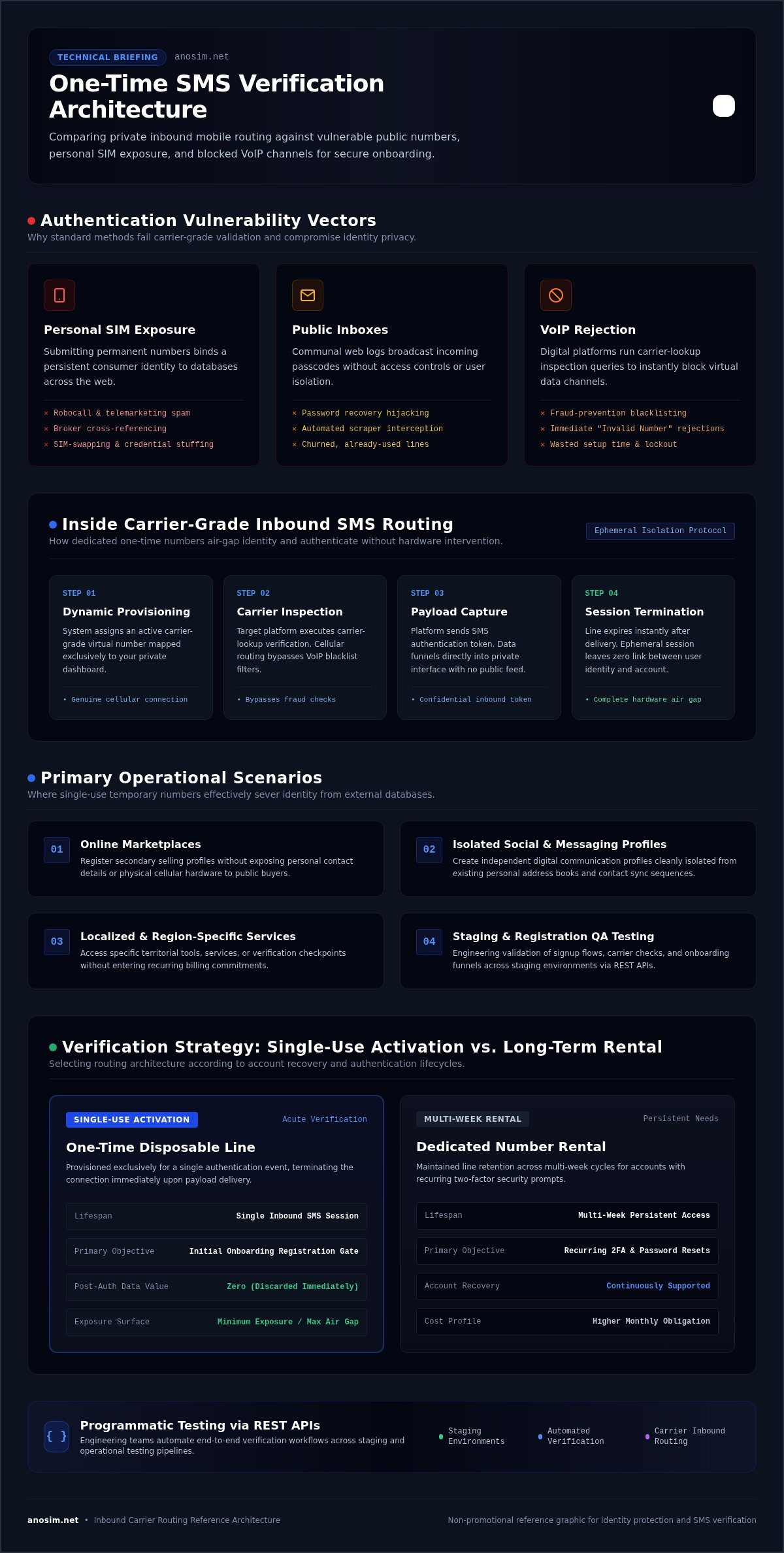
An isolated SMS activation functions as a dedicated, inbound-only routing pipeline that funnels verification data straight to a secure interface without requiring hardware intervention. Inbound text routing relies on carrier-grade cellular connections rather than unverified data channels. When you request access, the infrastructure dynamically assigns an active virtual phone number mapped directly to your private dashboard. Once the sender platform transmits the token, the system captures the message and immediately terminates the session, ensuring complete disposal.
Primary Personal Number vs. One-Time Disposable Number
Entering your real SIM details online creates a permanent, searchable identifier that data brokers cross-reference across consumer databases. It exposes you directly to automated robocall campaigns, credential stuffing, and SIM-swap fraud. A disposable number isolates these hazards by discarding the identifier immediately after authentication.
Single-use activations solve acute verification hurdles. However, if an account requires recurring two-factor security prompts or periodic password resets, a persistent rental line is the appropriate choice. When your only objective is passing an initial registration gate, a single-use activation provides maximum privacy with minimum exposure.
Why Free Public Number Sites Fail for Critical Account Verification
Public SMS aggregators look convenient at first glance, but their underlying architecture makes them unsuitable for secure authentication. These websites route incoming messages to open, communal web logs accessible to anyone on the internet. Because hundreds of users churn through the same handful of lines every hour, major online services quickly flag and blacklist those numbers in their fraud-prevention databases.
Cycling through dead public numbers wastes time. You might attempt five or six verification sequences only to receive an immediate "number invalid" or "already registered" alert. Government agencies like the Federal Communications Commission highlight the dangers of sharing your number across unverified spaces, but using a shared public directory creates an entirely different security hazard by broadcasting your account activities to strangers.
The Security Pitfalls of Shared Public Inboxes
Public SMS portals expose your authentication codes to anyone refreshing the page. If you use a shared number to register an account, any subsequent visitor can enter that same phone number into the service's login portal, trigger a password recovery sequence, and read the reset token directly from the public feed. Shared numbers lack access controls entirely. Instead of shielding your identity, open directories expose your newly created credentials to immediate takeover by automated scrapers monitoring the inbox.
Carrier Filtering and VoIP Rejection Systems
Top-tier digital services don't just rely on usage history to block signups. They run automated carrier-lookup queries during form submission to inspect the line's connection type. Standard virtual numbers usually return a Voice over Internet Protocol (VoIP) classification, which security engines often reject to deter bulk bot registrations.
Free portals almost exclusively operate on low-cost VoIP lines. When an authentication engine detects a VoIP carrier tag coupled with high registration velocity, it terminates the onboarding session before dispatching an SMS. If your goal is to get a temporary number for one-time use without platform rejections, private routing backed by carrier-grade mobile pools ensures codes arrive promptly without exposing your data.
How to Get a Temporary Number for One-Time Use
Acquiring a disposable line requires a structured sequence to ensure the incoming payload clears automated fraud filters. Unlike public aggregators where you simply grab an arbitrary digit string, dedicated activations map your incoming request to specific carrier pools. Following a direct step-by-step workflow guarantees quick authentication without leaving persistent personal breadcrumbs behind.
- Define the target platform and country: Identify the application you're registering and match the line's origin with your operational region.
- Provision a dedicated line: Skip exhausted public directories and secure an isolated, inbound-only routing channel.
- Submit the digits: Paste the temporary mobile number directly into the target platform's SMS registration field.
- Capture the payload: Track your private web dashboard console in real time to view the incoming alphanumeric code.
- Finalize and terminate: Submit the one-time passcode into the target application and allow the activation session to close automatically.
When you get a temporary number for one-time use, this straightforward lifecycle isolates your real mobile hardware from aggressive third-party data tracking.
Selecting the Target Platform and Country Route
Fraud prevention systems scrutinize inconsistencies between your network profile and your submitted phone number. If your browser connection originates from one territory while your mobile number belongs to another, security filters may reject the entry outright. Specifying the target application during setup routes your request through carrier channels optimized for that platform's SMS delivery protocols. Using dedicated SMS Activation helps ensure that the assigned digits haven't been recycled on that platform, bypassing immediate velocity blocks.
Receiving the OTP and Finalizing Account Setup
After triggering the verification dispatch on the target service, keep your browser terminal open. The inbound SMS payload appears directly within your secure console feed, eliminating the need to install third-party forwarding apps or handle hardware SIMs. Most verification codes remain active for only two to five minutes. Copy the incoming passcode into the target site immediately to complete onboarding before the window closes.
Single-use activations discard the number once the verification completes, making them perfect for standalone registrations. For workflows requiring continuous account access, ongoing identity checkpoints, or periodic re-authentication, exploring Rent Number options provides dedicated line retention across days or weeks.
Comparing Verification Options: One-Time Activation vs. Long-Term Number Rental
Choosing between an instantaneous activation and a multi-week rental comes down to your account lifecycle requirements. While both options isolate personal data from online trackers, their routing configurations serve fundamentally different operational objectives. Deploying the wrong solution can leave accounts vulnerable to sudden recovery lockouts.
Single-use numbers prioritize complete disposal, whereas rental configurations prioritize persistent availability. Evaluating your need for recurring account access helps you decide whether to get a temporary number for one-time use or retain dedicated routing over an extended timeframe.
When Single-Use SMS Activation Is the Superior Choice
Single-use activations work best for static registrations where platforms verify identity once and never challenge it again. Testing staging flows, signing up for digital forum access, and setting up isolated classified profiles require no persistent cellular link. You receive the inbound token, submit the verification payload, and the line terminates immediately. Operational overhead drops to zero because you maintain no recurring balance commitments or dormant lines.
When Your Workflow Demands Dedicated Number Rental
High-security services take the opposite approach. Banking interfaces, fintech wallets, and enterprise collaboration platforms routinely trigger secondary authentication challenges whenever they flag a new browser fingerprint or unfamiliar network route. If you register using an expired activation line, an unexpected security challenge locks you out permanently.
For services requiring ongoing credential validation, our Rent Number service reserves a dedicated line exclusively for your accounts. Securing an extended rental preserves your ability to receive future password resets and periodic two-factor authentication tokens whenever security algorithms require secondary validation.
Pairing Temporary Numbers with High-Trust Network Infrastructure
Advanced platform algorithms don't inspect cellular numbers in a vacuum. Anti-fraud systems cross-reference carrier metadata with incoming IP addresses, browser canvas data, and hardware fingerprints. Registering with an American phone number while routing network requests through an unrelated European data center immediately flags account creation as suspicious.
Maintaining high trust across automated checks requires holistic credential alignment. To pass rigorous onboarding scrutiny without unexpected flag triggers, pair your disposable lines with residential or mobile proxies matching the target telephone country code, for example from Anosim partner proxied.com. If you need clean, carrier-grade lines for your next deployment, get a temporary number for one-time use with Anosim to verify your accounts without platform rejections.
Scaling Disposable Verification: Developer APIs and Workflow Automation
Engineering teams frequently need to test user registration pipelines, authentication logic, and notification pathways across pre-production environments. Manually provisioning credentials through a browser interface quickly creates development bottlenecks. Instead of handling manual inputs, automated QA test suites query REST endpoints to programmatically acquire lines, receive inbound strings, and validate registration forms in seconds.
Automating verification testing eliminates the friction of human oversight. When development workflows require scripts to get a temporary number for one-time use, API architectures provide structured JSON payloads that integrate cleanly with continuous integration pipelines. Systems poll the endpoint for the incoming SMS token, parse the numerical string with regular expressions, and pass it directly into browser automation scripts like Playwright or Selenium.
API Protocols for Programmatic Temporary Number Requests
Infrastructure flexibility depends on adopting established protocols. Engineering workflows can deploy our native API documentation using the Anosim API (v1) architecture, which provides granular parameter controls for country codes, platform selection, and immediate session termination. Teams migrating from existing tooling can also implement drop-in automation using the SMS-Activate Standard API schema, avoiding the need to rewrite core telecommunications wrappers or data collection scripts.
Best Practices for Resilient Automated Signups
Network latency and carrier routing fluctuations mean automated testing scripts must account for edge cases. Building resilient testing architecture requires defensive coding patterns:
- Dynamic retry logic: If a targeted carrier pool experiences delivery delays past your timeout threshold, cancel the activation automatically and request a line from a secondary provider pool.
- Automated session cleanup: Terminate requests that don't receive an SMS payload within the expected timeframe to free up concurrent allocation limits.
- Immediate payload sanitization: Discard verification codes from system logs and memory immediately after database confirmation to preserve security hygiene.
Scaling automated signups without false-positive platform rejections comes down to carrier quality. Relying on carrier-grade routing ensures your automated sequences encounter genuine mobile channels rather than flagged endpoints. Through programmatic routing, you can systematically get a temporary number for one-time use that satisfies strict carrier checks across any test volume.
Secure Your Digital Identity with Private Verification
Relying on public SMS lists exposes your accounts to hijack attempts and guarantees platform rejections. Passing modern security checkpoints demands isolated infrastructure that delivers one-time passcodes without publishing them to an open directory. Choosing carrier-grade mobile routes over recycled virtual lines protects your personal SIM from corporate data breaches, credential stuffing, and unsolicited marketing lists.
Whether you're registering a single marketplace account or scaling continuous staging deployments across development pipelines, private inbound routing keeps your operations seamless. Dedicated architecture isolates authentication data entirely, while dual API integration support through the Anosim API (v1) and SMS-Activate Standard API ensures smooth programmatic automation for engineering workflows.
Take control of your data privacy today. Whenever you need to get a temporary number for one-time use, choose reliable routing with zero shared inboxes to guarantee complete confidentiality. Get your private temporary number for verification on Anosim and authenticate your accounts securely on the first attempt.
Frequently Asked Questions
Can I use a temporary number to receive verification codes from any service?
Yes, private temporary numbers can receive verification passcodes from virtually any digital platform, provided the line uses carrier-grade mobile routing rather than low-quality consumer VoIP. Selecting the exact application beforehand ensures the backend provisions a clean number unflagged by that service's anti-abuse filters. While free public aggregators face widespread bans across restrictive services, dedicated single-use activations reliably deliver codes for marketplaces, social networks, and messaging platforms.
Will anyone else have access to the SMS verification code sent to my temporary number?
No, incoming authentication codes remain entirely private to your personal dashboard session. Unlike public SMS directories that display received messages on an open web feed, private activation architecture uses isolated routing pipelines. The token appears solely within your authenticated console. Once the session terminates or expires, the system permanently closes the line, preventing subsequent users or automated scrapers from accessing your verification messages.
What happens if the platform does not send the SMS code within the activation window?
If an online service delays or fails to transmit the verification code before the activation window closes, the temporary session simply cancels. You aren't billed for unreceived codes or failed activations. You can immediately request a new line from an alternate carrier route or country pool to complete the registration. Configuring quick timeouts prevents your onboarding workflow from stalling when external platform gateways experience transient routing delays.
Why do some websites block virtual phone numbers during registration?
Online services block virtual numbers primarily to deter automated bot farms, multi-accounting, and spam abuse. During onboarding, security systems perform automated lookup queries to verify the carrier classification. If the query identifies a low-cost VoIP line or a number previously associated with hundreds of registrations, the platform rejects it outright. When you get a temporary number for one-time use from dedicated mobile pools, it returns legitimate carrier metadata, passing fraud checks seamlessly.
Can a temporary one-time number make outgoing calls or send text messages?
No, temporary one-time numbers operate strictly as inbound channels. They are engineered exclusively to receive incoming short message service payloads like one-time passcodes and account verification links. Infrastructure providers do not provision outbound voice calling, text messaging, or physical SIM hardware for these disposable lines. This inbound-only architecture preserves operational simplicity, reduces transmission overhead, and maintains rigorous security boundaries across all disposable routing sessions.
How long does a one-time temporary phone number remain active?
A single-use temporary number remains active just long enough to capture the authentication token, typically between ten and twenty minutes. As soon as the inbound message arrives and you retrieve the code, the session terminates. If no message arrives within the allocation window, the system cancels the reservation automatically. For operations requiring continuous access across days or weeks, extended number rentals should be selected instead.
Is it legal to use a temporary virtual number for account verification?
Yes, using temporary numbers for digital identity protection and software testing is completely legal. Privacy-conscious individuals frequently choose to get a temporary number for one-time use to shield personal information from telemarketing databases and corporate data breaches. However, users must always adhere to the terms of service of the target platform. Utilizing virtual lines to bypass legitimate security bans, conduct financial fraud, or execute automated spam campaigns remains prohibited.