
With 8.3% of all global account creation attempts flagged as fraud in 2025, platforms have shifted their defense mechanisms upstream to the very moment of registration. You've likely felt this shift firsthand through rising ban rates and the constant struggle to source non-VoIP numbers that actually work. It's frustrating to see your infrastructure flagged before the first session even begins. This guide provides the technical blueprint for mastering the best practices for account creation automation, ensuring your workflows remain invisible to modern anti-bot engines. You'll learn how to build a resilient "Trust Stack" that aligns your network, carrier, and browser layers for maximum account longevity.
Mastering these workflows requires more than just basic scripts. We'll examine how to navigate the transition to JA4+ TLS fingerprinting and why carrier-grade NAT (CGNAT) on mobile proxies is now a non-negotiable requirement for high-trust IP reputations. We also cover the strategic shift from disposable SMS to long-term number leasing and seamless API integration. By the end of this guide, you'll have the framework needed to reduce operational costs while maintaining stable, long-lasting automated accounts that can withstand deferred re-verification triggers.
Key Takeaways
- Understand the technical evolution from basic macro scripts to sophisticated browser-based automation that mimics human behavior.
- Learn how to build a high-trust environment by synchronizing mobile proxies with inbound SMS activation to bypass carrier-grade security filters.
- Discover how to scale your operations programmatically by integrating the Anosim API (v1) into your custom registration scripts.
- Master the best practices for account creation automation by implementing mandatory warm-up periods and maintaining consistent networking layers.
- Ensure account survival by utilizing long-term number rentals to handle deferred re-verification prompts and security triggers.
Table of Contents
- The Fundamentals of Account Creation Automation in 2026
- Building the Trust Stack: Mobile Proxies and SMS Verification
- API Integration for Scalable Verification Workflows
- Mitigating Risks: Best Practices for Account Longevity
- Implementing a Secure Automation Pipeline with Anosim
The Fundamentals of Account Creation Automation in 2026
For modern digital marketing operations, account creation automation is the programmatic generation of user profiles on external platforms. It's a critical component for professionals who manage large-scale digital assets without the manual overhead of individual registrations. While early automation relied on simple macro scripts that repeated clicks, the current environment requires sophisticated browser-based systems. These tools must navigate platforms that use AI-driven behavioral analysis to distinguish between legitimate users and automated scripts.
The core objective is to maintain a high trust score. Platforms don't just look for successful form submission; they evaluate the entire journey from the landing page to the final verification step. Adhering to best practices for account creation automation means prioritizing environmental consistency over raw speed. If your automation doesn't mimic human behavior, it's likely to be flagged before the account is even active.
The Anatomy of a Modern Signup Process
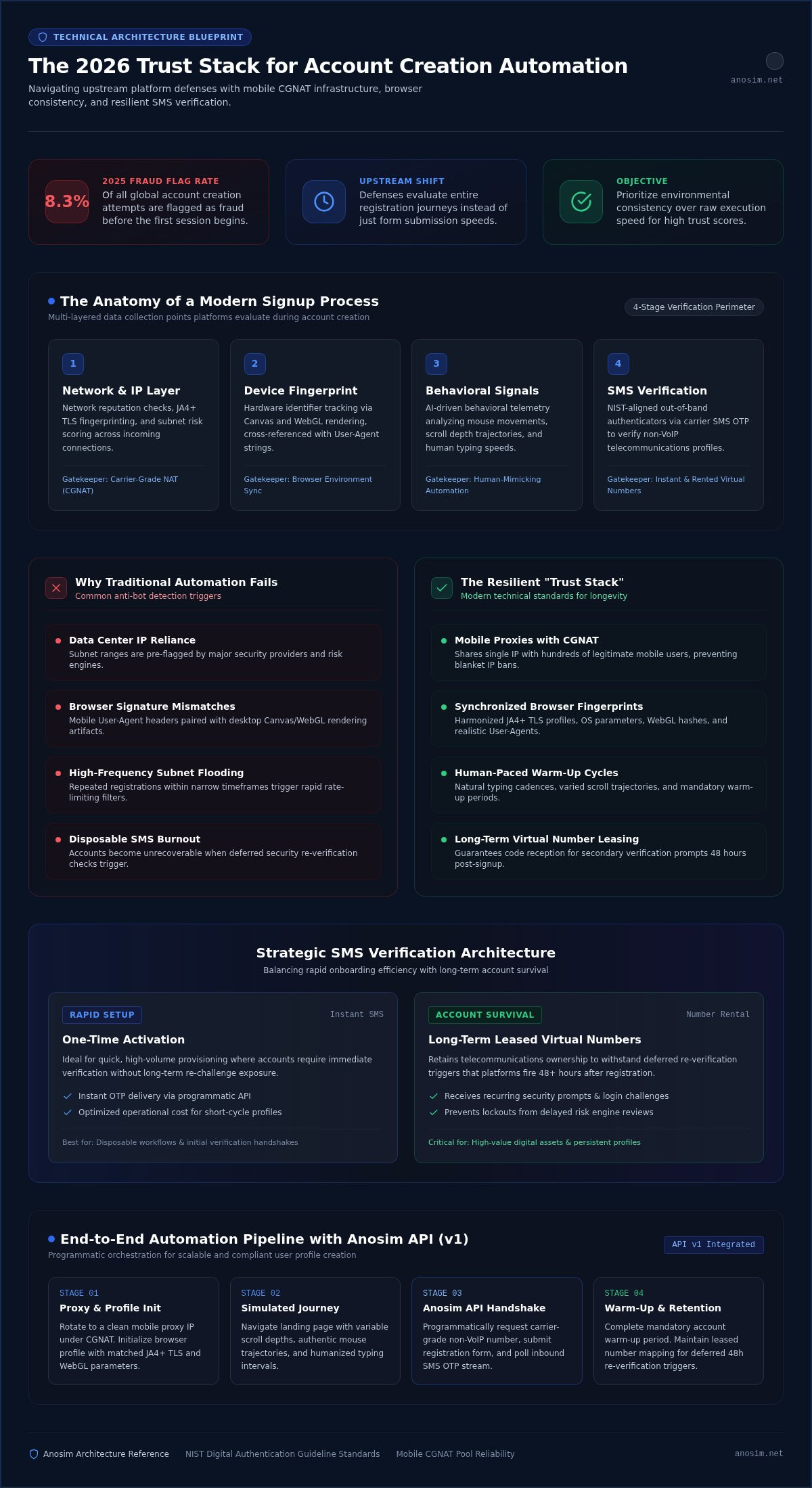
Platforms utilize multi-layered data collection points to verify identity. This includes analyzing the IP address, network reputation, and hardware configurations through advanced device fingerprinting techniques. These methods allow services to track hardware identifiers even when a user clears their cookies or changes their proxy. Beyond hardware, behavioral signals play a vital role. Systems monitor mouse movements, scroll depth, and typing speed to ensure a human is behind the screen. Finally, third-party verification through SMS OTP acts as the primary gatekeeper, requiring a reliable telecommunications layer to complete the registration.
Why Traditional Automation Fails
Many automation projects fail because they ignore the reputation of their infrastructure. Relying on data center IPs is a common pitfall; these ranges are often pre-flagged by major security providers. Another frequent issue is the mismatch between browser signatures. If a User-Agent string claims to be a mobile device but the Canvas or WebGL rendering suggests a desktop environment, the platform's risk engine will trigger a ban. Rate limiting also remains a significant hurdle. Attempting high-frequency registrations from a single subnet or within a narrow time window is a clear signal of non-human activity. Implementing best practices for account creation automation requires a shift toward mobile-first infrastructure and clean verification paths. For more details on how to avoid these common errors, you can visit the Anosim FAQ.
Building the Trust Stack: Mobile Proxies and SMS Verification
Success in automation depends on the "Trust Stack." This is the alignment of your digital environment with the platform's expectations. Implementing best practices for account creation automation requires a dual-layered approach: clean networking and verified identity signals. Without both, even the most sophisticated browser fingerprinting will fail to bypass modern security perimeters.
The Power of Mobile Proxies
Mobile proxies represent the gold standard for registration workflows in 2026. Unlike data center IPs, which are easily identified, mobile IPs benefit from the trust associated with major cellular carriers. Platforms rarely ban mobile IP ranges because they utilize Carrier-Grade NAT (CGNAT), where a single IP is shared by hundreds of legitimate users. Banning that IP risks blocking real customers. Rotating mobile proxies, such as those from Anosim partner proxied.com, allow you to cycle through these high-trust pools, ensuring each registration attempt appears as a unique mobile subscriber.
Strategic SMS Activation
Verified identity is the second pillar of the stack. While network reputation gets you through the door, SMS activation completes the handshake. Following NIST digital authentication guidelines, many platforms now mandate out-of-band authenticators like SMS OTPs to prevent bot-driven fraud. This layer confirms that a registration attempt is tied to a valid telecommunications profile rather than a headless script.
For rapid, one-time setups, instant SMS activation is efficient. However, long-term stability often requires rented virtual numbers. These allow you to receive recurring codes if a platform triggers a security check 48 hours after signup. This persistence is a core component of best practices for account creation automation. It prevents the loss of accounts during initial cooling periods or subsequent login attempts from new devices.
If you're targeting specific regions, international SMS activation services help bypass geographic restrictions by providing local carrier numbers. This ensures your identity signals match your proxy's location. For those building a new pipeline, starting with a reliable SMS activation service provides the necessary verification infrastructure for scalable growth.
API Integration for Scalable Verification Workflows
Scaling account creation requires moving beyond manual interaction. Manual workflows are prone to human error and lack the speed necessary for large-scale operations. Programmatic integration ensures that your scripts can request a number, receive an OTP, and finalize registration without interruption. This level of control is central to the best practices for account creation automation. By utilizing the Anosim API (v1), you can embed these telecommunication steps directly into your code. For teams using existing bulk creation software, the platform's support for the SMS-Activate Standard API allows for a seamless transition without needing to rewrite entire modules.
Standardizing Your API Workflow
A structured lifecycle prevents account loss and optimizes resource usage. You should follow a logical sequence to ensure every registration attempt has the highest chance of success. First, authenticate with the Anosim API using your unique API key. Once authenticated, select the target service and country for the SMS activation. It's critical to match these parameters with your proxy's geographic location to avoid triggering regional security flags. After submitting the number to the signup form, your script should poll the API for the incoming verification code. Include proper retry logic to account for varying delivery speeds. Finally, release the number once the code is parsed, or extend the rental if the account requires long-term access for subsequent security checks.
Error Handling and Rate Limit Management
Platforms actively monitor for mass registration patterns. The OWASP automated threat framework identifies mass account creation (OAT-019) as a primary target for security defenses. To stay under the radar, your API integration must handle rate limits gracefully. Implementing exponential backoff ensures that your script doesn't trigger IP-based throttling from the API itself. If a number fails to receive a code within the expected window, your script should automatically cycle to a new virtual number. This redundancy is a core part of maintaining best practices for account creation automation. Programmatic monitoring of your mobile proxy health during this flow is equally important. If a proxy subnet is flagged, the entire registration session should be aborted before wasting a verification credit. This pragmatic approach minimizes operational waste and protects your account trust scores.
Mitigating Risks: Best Practices for Account Longevity
Longevity is the ultimate metric for success in any automated pipeline. Creating thousands of profiles is trivial compared to keeping them active beyond the initial 48 hour cooling period. When implementing best practices for account creation automation, you must treat the post-registration phase as a high risk window. Major platforms now deploy deferred re-verification triggers, often prompting for a new OTP 24 to 72 hours after the account is born. If you can't satisfy these subsequent checks, your initial investment in registration is wasted. Maintaining environmental consistency and mimicking organic growth patterns are non-negotiable for long term survival.
Account Warm-up and Human Emulation
Freshly created accounts shouldn't immediately perform high volume actions like mass messaging or rapid scraping. This behavior triggers velocity limits and signals non-human activity to risk engines. Instead, aim for a gradual increase in activity to mimic organic user growth. Start by simulating realistic sessions; this includes uploading profile pictures, updating bios, and performing low stakes initial interactions. It's also vital to avoid leaving "footprints" in your data. Vary your registration times and batch sizes so your activity doesn't follow a predictable, machine-like schedule. By spreading out your operations, you stay beneath the radar of AI-driven behavioral analysis.
Long-Term Verification Maintenance
Consistency in your networking layer is the foundation of account stability. Pairing specific accounts with dedicated mobile proxies ensures that every login attempt originates from a trusted IP subnet. Using the same mobile IP range for the life of the account prevents the "impossible travel" flags that occur when an account jumps between data centers. Beyond networking, you must protect your primary phone number from data leaks by using virtual infrastructure for all signups.
For platforms known for frequent security prompts, the use of dedicated virtual numbers is essential. These numbers allow you to receive recurring verification codes, preventing lockouts during routine profile changes or password resets. If a platform verifies by phone call instead of SMS, a Mobile VoIP rental lets you receive calls as well as SMS on the same line. Always set up alerts for number rental expirations to ensure you never lose access to your verification line. Adhering to these best practices for account creation automation will significantly reduce your operational costs per surviving account. Start building stable, long-lasting accounts today with reliable verification infrastructure.
Implementing a Secure Automation Pipeline with Anosim
Anosim serves as the silent infrastructure partner for professionals who require high-trust verification at scale. While previous sections focused on the technical requirements of the Trust Stack, this final stage covers the practical implementation. Before committing to a fully automated API workflow, it's efficient to navigate the Anosim dashboard for manual testing. This allows you to verify platform-specific requirements and check which countries and services are currently in stock. Leveraging global coverage is essential for creating geographically diverse account portfolios that resist pattern-based detection.
Choosing the Right Service for Your Scale
Selecting the appropriate verification model depends on your account's intended lifecycle. For rapid, one-time registrations where long-term access isn't required, SMS Activation is the most cost-effective choice. However, if you're building assets on platforms with aggressive re-verification triggers, using the Rent Number service is a core component of best practices for account creation automation. This ensures you retain access to the same SIM profile for subsequent security checks. Always select mobile proxies that match the target platform's geography to maintain environmental consistency. If you're unsure about specific service compatibility, consulting the Anosim FAQ answers the most common questions.
Scaling with Anosim Partners and Affiliates
For high-volume operations, the Partners program offers tailored support for enterprise-level requirements. If you're developing your own automation platform, integrating as a Reseller allows you to provide verification infrastructure directly to your users. Following best practices for account creation automation requires a final verification of your pipeline before launch.
Use this checklist to ensure your system is ready:
- Confirm your mobile proxy IP matches the region of your virtual number.
- Validate that your browser fingerprints don't leak WebRTC or Canvas data.
- Ensure your API retry logic accounts for variable SMS delivery times.
- Verify that your account warm-up scripts include realistic human delays.
Setting up your developer account and choosing a proxy provider such as Anosim partner proxied.com are the final steps toward a resilient automation strategy. By aligning your verification layer with clean mobile networking, you minimize the risk of bans and maximize the ROI of your digital assets.
The success of your automation pipeline depends on the synergy between your network reputation and verification signals. Achieving high trust scores requires a "Trust Stack" that pairs clean mobile proxies with non-VoIP carrier numbers. Implementing these best practices for account creation automation ensures your profiles survive initial security filters and deferred re-verification triggers. By automating the entire lifecycle through API integration, you reduce manual overhead while maintaining the technical robustness needed to bypass modern anti-bot systems.
Anosim provides the silent infrastructure necessary for these complex operations. With support for API v1 and SMS-Activate Standard API compatibility, you can integrate secure, inbound-only SMS verification into any custom script. Whether you need instant activations or long-term rentals for recurring verification, the right tools are available to help you scale. Start Automating Securely with Anosim Infrastructure and build a resilient digital footprint that lasts. Your path to efficient, high-trust automation begins with a solid foundation.
Frequently Asked Questions
What are the most important factors for account creation automation success?
Success depends on the alignment of the "Trust Stack," which includes high-trust mobile networking, clean browser fingerprints, and verified identity signals. Implementing the best practices for account creation automation requires using non-VoIP numbers and mobile proxies to mimic legitimate human behavior. If your network reputation doesn't match your device profile, platforms will trigger immediate bans. Consistency across these layers is the foundation of a resilient and scalable automation pipeline.
Can I use free virtual numbers for automated account verification?
Public free numbers, including Anosim's own free numbers, are fine for testing how SMS reception works, but they are unsuitable for professional automation because many users share them and platforms often reject them. These numbers lack the carrier-grade reputation required to bypass modern security filters. For reliable results, you should use premium SMS Activation or Rent Number services. These provide clean, private numbers from legitimate cellular ranges, ensuring your verification codes arrive and your accounts remain stable over time.
How do mobile proxies prevent account bans during registration?
Mobile proxies utilize Carrier-Grade NAT (CGNAT) technology, which maps hundreds of mobile subscribers to a single public IP address. Platforms avoid banning these IPs because doing so would cause collateral damage to legitimate smartphone users. By routing your registration traffic through mobile proxies, you benefit from this inherent trust. This technique allows you to create multiple accounts from the same subnet while appearing as a unique, legitimate mobile user to the platform's risk engine.
Is it better to use SMS activation or long-term number rentals for automation?
The choice depends on your account lifecycle and the platform's security triggers. SMS Activation is efficient for rapid, high-volume registrations where you don't expect future verification checks. However, for platforms that issue deferred re-verification prompts 48 hours after signup, long-term rentals are a core part of best practices for account creation automation. Renting a number ensures you can satisfy subsequent security challenges without losing access to the account or your initial investment.
What is browser fingerprinting and how does it affect account automation?
Browser fingerprinting is a technique used to identify and track users based on unique hardware and software configurations. This includes Canvas rendering, WebGL signatures, and audio context anomalies. In account automation, a mismatch between your proxy location and your browser's internal clock or language settings is a red flag. Successful automation requires anti-detect browsers or patched binaries that can spoof these fingerprints to match the profile of a real human user on a specific device.
How do I integrate SMS verification into my Python or Node.js automation script?
Integration is achieved through RESTful requests to the Anosim API (v1). You can use libraries like requests in Python or axios in Node.js to programmatically request a number and poll for the incoming code. Because Anosim supports the SMS-Activate Standard API, many existing automation tools can integrate these services by simply updating the host URL and their API key.
What should I do if a platform rejects a virtual phone number?
If a platform rejects a virtual number, it is usually because the carrier range has been flagged as low-trust or VoIP. You should immediately cycle to a different country or switch to a carrier-issued number on a physical SIM card instead of a VoIP line. It's also important to verify that your mobile proxy region matches the number's country code. Environmental inconsistency is frequently the root cause of number rejection during signups.
How many accounts can I safely create per mobile proxy IP?
There is no universal limit, but mobile proxies are significantly more resilient than residential or data center IPs. Because mobile IPs are shared via CGNAT, you can often create more accounts per IP before triggering velocity limits. However, the best practice is to rotate your mobile proxy IP frequently. Spreading your registration attempts across different subnets and varying your batch sizes helps prevent the detection of machine-like patterns that lead to mass account termination.