Your virtual numbers aren't failing verification checks because of bad luck; platform security filters reject cloud PBX ranges the millisecond you hit submit. If you've hit the "This phone number cannot be used for verification" error on services like Google, Tinder, or Telegram, you already know standard virtual lines won't cut it. Securing an authentic non-voip number for verification is no longer optional if you need reliable digital identity workflows that survive carrier scrutiny.
You've probably wasted time cycling through recycled number pools, only to watch fresh accounts get suspended during post-registration audits. It's frustrating to burn resources when automated systems silently block your requests before an SMS even leaves the carrier gateway. In this guide, you'll learn how platform risk engines inspect routing metadata, why cloud-hosted lines trigger immediate blacklists, and how to secure true mobile network routing for both single OTP activations and long-term rentals. We'll break down the telecommunications architecture separating virtual ranges from genuine cellular infrastructure so you can maintain permanent account stability.
Key Takeaways
- Platform risk engines drop virtual numbers within 200 milliseconds by querying carrier routing metadata before an SMS is even dispatched.
- Using an authentic non-voip number for verification backed by physical mobile network operator routing prevents immediate blacklisting and post-registration bans.
- Comparing one-time SMS activations against dedicated number rentals ensures you match the line lifespan to your platform's re-authentication requirements.
- Pairing mobile proxies from Anosim partner proxied.com with clean inbound lines synchronizes network telemetry to prevent risk engines from flagging hardware and IP mismatches.
- Automating inbound workflows via the Anosim API (v1) or SMS-Activate Standard API allows you to scale line provisioning and code polling seamlessly.
Table of Contents
- What Is a Non-VoIP Number & Why Verification Needs It?
- Non-VoIP vs. VoIP Numbers: A Comprehensive Technical Comparison
- Common Verification Pitfalls and How Modern Risk Engines Detect Numbers
- How to Choose the Right Non-VoIP Strategy: Activation vs. Long-Term Rental
- Implementing Non-VoIP Verification at Scale: API Workflows and Automation
What Is a Non-VoIP Number & Why Verification Needs It?
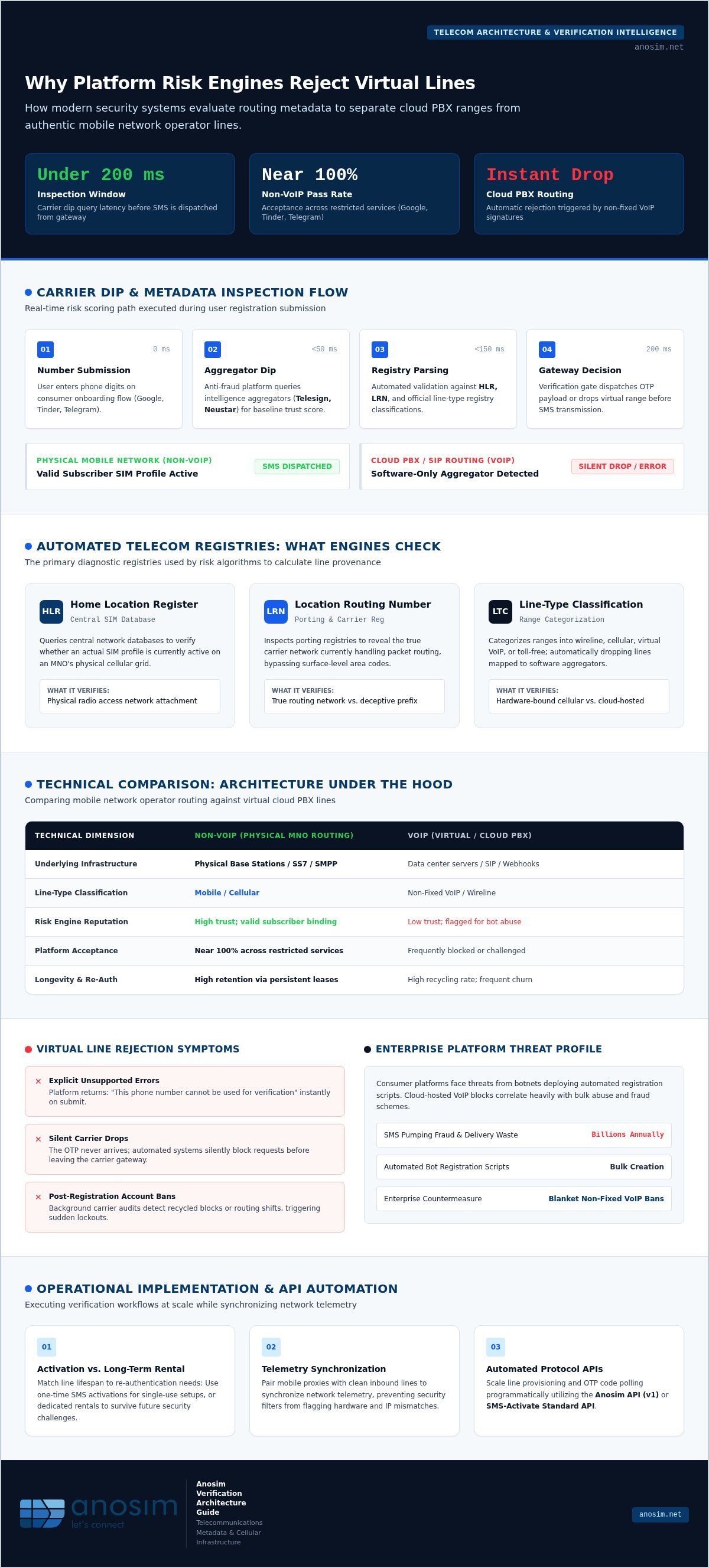
A non-VoIP number is a telephone line provisioned directly by a physical mobile network operator (MNO) and assigned to dedicated subscriber identity module (SIM) routing. Unlike virtual telephony numbers configured via cloud private branch exchange (PBX) software and Session Initiation Protocol (SIP), a true cellular line connects through physical radio access networks. When you enter a phone number on a modern platform, anti-fraud systems execute carrier dip queries to determine the underlying routing metadata in under 200 milliseconds. If the platform flags the line as cloud-hosted, verification fails immediately.
The core issue stems from protocol origins. The standard Voice over IP architecture routes communications over packet-switched data networks without requiring physical hardware binding. Because platforms can detect this routing signature instantly, using a virtual line triggers clear rejection symptoms. These include explicit errors stating the number is unsupported, silent drops where the one-time passcode (OTP) never arrives, or sudden account lockouts moments after registration. Using an authentic non-voip number for verification circumvents these filters by presenting legitimate mobile network credentials directly to the gateway.
The Mechanics of Carrier Lookups: HLR, LRN, and Line-Type Intelligence
Security engines determine line provenance using automated telecom registries:
- Home Location Register (HLR) Lookups: Queries ping central network databases to verify whether a SIM profile is currently active on an MNO's cellular grid.
- Location Routing Number (LRN) Queries: These checks inspect porting registries to reveal the true carrier network currently handling packet routing, bypassing surface-level area codes.
- Line-Type Classification: Algorithms categorize numbers into wireline, cellular, virtual VoIP, or toll-free ranges, automatically dropping lines mapped to software-only aggregators.
Why Platforms Like Google, Telegram, and Tinder Reject VoIP Numbers
Consumer platforms face massive threats from botnets running automated registration scripts. Major apps deploy sophisticated risk engines to inspect phone metadata alongside device footprints. Cloud-hosted VoIP blocks correlate heavily with bulk account creation and SMS pumping fraud, which cost enterprises billions annually in wasted delivery fees. Consequently, security firewalls blanket-ban non-fixed VoIP ranges to protect platform integrity. Beyond initial onboarding, platforms run periodic background carrier audits. If a previously accepted profile shifts routing data or appears on a recycled virtual block, the system triggers secondary verification prompts or permanently bans the account.
Non-VoIP vs. VoIP Numbers: A Comprehensive Technical Comparison
Understanding why automated platforms reject virtual numbers requires examining the routing architecture under the hood. Risk scoring engines query databases operated by intelligence aggregators like Telesign or Neustar, calculating real-time trust ratings before dispatching an SMS. While virtual numbers appear cost-effective initially, their failure rate turns them into a financial sinkhole once you factor in registration dropouts, proxy burn, and account churn. Deploying an authentic non-voip number for verification eliminates these bottlenecks by routing traffic through genuine mobile network operator channels.
- Underlying infrastructure: non-VoIP numbers run over physical base stations with SS7 and SMPP signaling, while VoIP numbers terminate on data center servers via SIP or webhooks.
- Line-type classification: carrier databases list non-VoIP numbers as mobile or cellular lines; VoIP numbers show up as non-fixed VoIP or wireline.
- Risk engine reputation: a non-VoIP number carries high trust through a valid subscriber binding, whereas VoIP ranges have low trust and are often flagged for bot abuse.
- Platform acceptance: non-VoIP numbers are widely accepted, including on restricted services; VoIP numbers are frequently blocked or challenged.
- Longevity and re-authentication: persistent leases give non-VoIP numbers high retention, while VoIP pools recycle numbers quickly and churn often.
Telecom Infrastructure and Packet Routing Differences
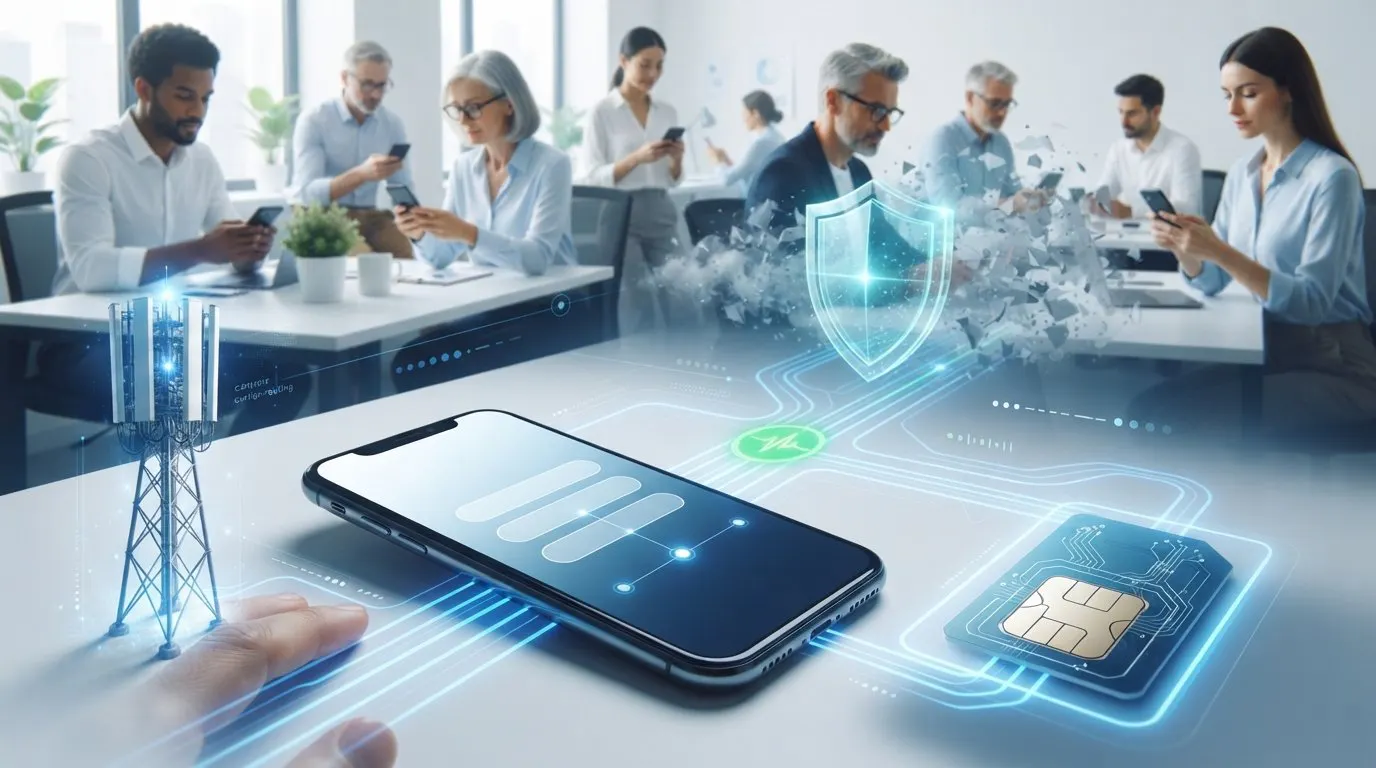
When an application sends an OTP to a cellular number, the payload traverses Short Message Peer-to-Peer (SMPP) gateways straight into the carrier's Short Message Service Center (SMSC). The SMSC routes the message across physical base station transceivers directly to a radio module. In contrast, virtual VoIP platforms terminate incoming traffic at a remote server via SIP or HTTP POST webhooks. This leaves an immediate data-center digital footprint. MNO routing provides carrier-grade delivery receipts back to the sender, confirming real device reachability that cloud PBX endpoints cannot replicate.
Platform Acceptance and Regulatory Trust Factors
Regulatory frameworks heavily shape delivery policies. Modern US telecom standards enforce strict A2P 10DLC campaign vetting, while platforms reference the NIST digital identity guidelines on out-of-band authentication, which specifically discourage VoIP lines due to the lack of proven physical possession. If you manage long-term profiles that trigger periodic security checks, relying on cheap, recycled VoIP pools guarantees lockout. For persistent setups, pairing clean mobile proxies, for example from Anosim partner proxied.com, with dedicated inbound routing via Rent Number options ensures your digital footprint aligns with carrier expectations across the entire account lifecycle.
Common Verification Pitfalls and How Modern Risk Engines Detect Numbers
Acquiring a clean line is only half the equation. Modern security architectures do not evaluate phone numbers in isolation; they analyze an interconnected web of hardware, network, and behavioral telemetry. If your environment raises suspicion, the platform triggers an automatic drop before dispatching a code. Even when using a pristine non-voip number for verification, an operational mismatch across surrounding signals will burn the line instantly.
Anti-fraud engines combine carrier intelligence with active session tracking. Submitting a US mobile line while routing traffic through a flagged European data-center proxy creates an immediate geographical mismatch penalty. Platform risk scores spike instantly. At the same time, behavioral trackers monitor client-side interactions on the submission form. Pasting a code instantly from a clipboard or typing with mechanical, non-human keystroke latency indicates automated tooling, prompting secondary identity challenges or silent account drops.
The Triad of Detection: IP Subnets, Fingerprinting, and Phone Metadata
Authentication firewalls cross-reference three distinct layers during the verification handshake:
- Network Alignment: The geographic origin and autonomous system number (ASN) of your IP must match the mobile carrier profile. The FCC regulatory definition of VoIP highlights its reliance on broad data networks, which makes data-center subnets stand out immediately against real carrier routing.
- Browser Telemetry: Verification portals query canvas rendering, WebGL fingerprints, audio contexts, and hardware concurrency limits to uncover headless automation browsers.
- Cohesive Routing: Eliminating network-level discrepancies requires aligning your connection with verified carrier nodes, as detailed in our guide on mobile proxy configurations.
Number Recycling Risks and the Burnout Cycle
Public verification portals pool and recycle lines aggressively, creating severe account liabilities. When a public cellular number passes between multiple users, it accumulates an abusive digital history. If a previous registrant used that line for spam on a specific platform, the service associates the entire carrier block with elevated fraud risk. Carrier quarantine intervals rarely exceed standard cooldowns, meaning a recycled SIM often carries latent penalties into fresh registrations. Once an anti-fraud engine flags an associated profile, it can trigger a cascading suspension across all accounts sharing linked recovery vectors, device hashes, or shared IP footprints.
How to Choose the Right Non-VoIP Strategy: Activation vs. Long-Term Rental
Selecting the appropriate line type depends entirely on your target account lifecycle. Not every automated workflow demands permanent retention; similarly, treating a mission-critical production profile as a disposable asset leads to permanent lockouts. Choosing an authentic non-voip number for verification requires evaluating whether a platform enforces periodic identity challenges or uses telephone verification solely as a one-time anti-bot gateway.
If an account holds financial assets, customer communications, or core development infrastructure, line stability dictates operational continuity. Conversely, ephemeral registrations prioritize isolation and cost efficiency over retention.
One-Time SMS Activation: Ephemeral Account Creation
Single-use activations serve disposable testing environments, forum profiles, classified listings, and basic application sandboxes. In this setup, an MNO-routed number is provisioned for a brief inbound window, usually lasting ten to twenty minutes. Once the gateway detects and delivers the incoming OTP, the session completes. If an SMS fails to arrive before the timeout, automated billing fallbacks release the line without charging your balance. Ephemeral activations offer maximum data privacy by preventing platforms from stitching disparate online activities together. If your operational requirement ends once onboarding finishes, provision an immediate line through the Anosim activation service.
Long-Term Number Rental: Sustained Account Governance and 2FA
Platforms like Telegram, WhatsApp, banking dashboards, and primary advertising consoles deploy continuous risk auditing. These services require routine re-authentication when detecting a new login location, an altered browser fingerprint, or a session reset. If your verification line expires after the initial registration, these challenges permanently lock you out of the account. Losing carrier continuity means losing the account itself. Our technical breakdown on the dedicated virtual number for sms approach explains the engineering behind private carrier reservation. For high-retention profiles, establish continuous access and eliminate recycling risks by provisioning dedicated lines through Anosim rental numbers.
Implementing Non-VoIP Verification at Scale: API Workflows and Automation
Automating verification across hundreds of account flows requires robust programmatic execution. Manual copy-pasting slows operations down and introduces human error into timing-sensitive authentication windows. A scalable infrastructure couples an authentic non-voip number for verification with automated endpoints capable of rapid request cycles, structured error handling, and clean session isolation.
Production environments execute programmatic line acquisition through a standardized four-step implementation framework:
- Request Dispatch: Your backend sends an authenticated request specifying target service identifiers and country codes.
- Line Provisioning: The gateway allocates an active cellular number from the carrier pool and returns an activation ID alongside the E.164-formatted line.
- Payload Polling: The script inputs the number on the target platform, then initiates a polling loop checking the endpoint for the incoming SMS payload.
- Line Release and Status Update: Upon successfully extracting the code, the client sends a completion status flag to close the transaction and release network resources.
API Integration Patterns: Anosim API v1 and Standard Endpoints
Developers can choose between proprietary interfaces and legacy protocol wrappers depending on existing tool stacks. Teams building bespoke software can leverage native REST methods, while those migrating legacy bot frameworks can connect via the SMS-Activate Standard API format. Both methods query balance thresholds, check country-level service inventory in real time, and poll line states over simple GET calls. Review endpoint definitions, response codes, and parameters in the Anosim API documentation.
Error Handling, Rate Limiting, and Operational Scaling
Robust pipelines anticipate delivery delays. Platforms occasionally drop outbound messages under heavy network load, making client-side timeout handling essential. Set polling intervals to three to five seconds to avoid local rate-limiting while monitoring a hard cutoff timer around fifteen minutes. If a code fails to arrive within the active window, the system should issue an automated cancellation call. This automatically triggers account balance reversals so failed deliveries don't consume operational budget.
Concurrently running multi-threaded scripts demands strict architectural hygiene. Never fire bulk verification requests from a single source address. Pair every provisioned line with a dedicated mobile proxy session, for example from Anosim partner proxied.com, to maintain IP-to-carrier coherence, ensuring your automated workflows scale cleanly without triggering systemic platform bans.
Build a Resilient Verification Pipeline for Long-Term Scale
Bypassing modern anti-fraud filters requires moving away from flagged cloud PBX ranges and anchoring your infrastructure in genuine carrier routing. Deploying an authentic non-voip number for verification ensures your incoming traffic passes deep HLR lookups and LRN queries without triggering immediate delivery drops or post-registration bans.
Account survival comes down to matching your line lifespan to your specific operational goals. Pure cellular MNO inbound routing protects your workflows whether you need single-use OTP activations for disposable testing or dedicated number leases for ongoing 2FA governance. Programmatic scale doesn't have to be complicated. With dual API support spanning the native Anosim API v1 and the universal SMS-Activate standard, integrating automated line provisioning, status polling, and balance monitoring into your existing software stack is seamless.
Stop losing accounts to carrier metadata mismatches. Provision high-trust non-VoIP numbers for instant verification on Anosim and establish a reliable, automated verification foundation today.
Frequently Asked Questions
Can online platforms detect if I use a virtual phone number instead of a physical SIM?
Yes, online platforms detect virtual numbers instantly by querying telecommunications databases like LRN and HLR registries during onboarding. These real-time carrier checks identify whether a line originates from a data-center cloud PBX or a mobile network operator. Because platforms prioritize fraud prevention, systems automatically flag and drop lines lacking true cellular routing before an SMS verification passcode is ever dispatched.
Why do services like WhatsApp, Google, and Telegram reject VoIP numbers?
Major platforms reject VoIP numbers to mitigate automated bot registrations, SMS pumping fraud, and malicious spam campaigns. Cloud-hosted VoIP blocks can be generated frictionlessly in bulk without subscriber identity verification, making them high-risk assets in anti-fraud scoring engines. Utilizing a clean non-voip number for verification bypasses these blacklists because mobile carrier lines carry proven trust credentials that satisfy strict fraud prevention thresholds.
What is the main technical difference between VoIP and non-VoIP phone numbers?
The fundamental difference lies in packet routing infrastructure and subscriber binding. VoIP numbers terminate at data-center servers using SIP or HTTP webhooks, completely decoupled from physical cellular equipment. Non-VoIP numbers route through mobile network operators, terminating directly at subscriber identity modules over SS7 and SMPP protocol channels. This architectural distinction allows risk assessment platforms to classify incoming requests into virtual or legitimate cellular categories.
What happens if an account requests a secondary verification code after registration?
If your service prompts for secondary re-authentication and you used an ephemeral single-use activation, you'll permanently lose account access once the initial session closes. Ephemeral lines release back to the carrier pool after code delivery. To survive subsequent security challenges or device migration prompts, you should utilize dedicated long-term number rentals, which maintain continuous inbound access to that exact line over extended operational lifespans.
How long does a temporary non-VoIP number stay active to receive an OTP?
Temporary activation lines typically remain active for ten to twenty minutes, providing ample time for incoming SMS delivery. During this window, polling systems monitor the line for the incoming OTP payload. If the service fails to dispatch the passcode before the allocation expires, automated balance protections release the line without debiting your funds, ensuring failed delivery attempts don't drain your balance.
Is it possible to automate non-VoIP number acquisition using developer APIs?
Yes, programmatic workflows easily handle line provisioning, payload polling, and line release cycles. Developers can integrate the native Anosim API (v1) or configure standard protocol endpoints via the SMS-Activate Standard API. These interfaces allow automated bots and registration scripts to request a non-voip number for verification, retrieve verification codes via structured GET queries, and manage timeouts without requiring manual human oversight.
Can I reuse the same non-VoIP number across multiple independent websites?
Yes, depending on whether you provision an activation or a rental line. One-time SMS activations are tied strictly to an individual target service during their active window. If you secure a dedicated rental line, however, you can receive inbound verification codes across multiple independent websites and applications simultaneously, giving you a unified, long-term cellular identifier across your full portfolio.