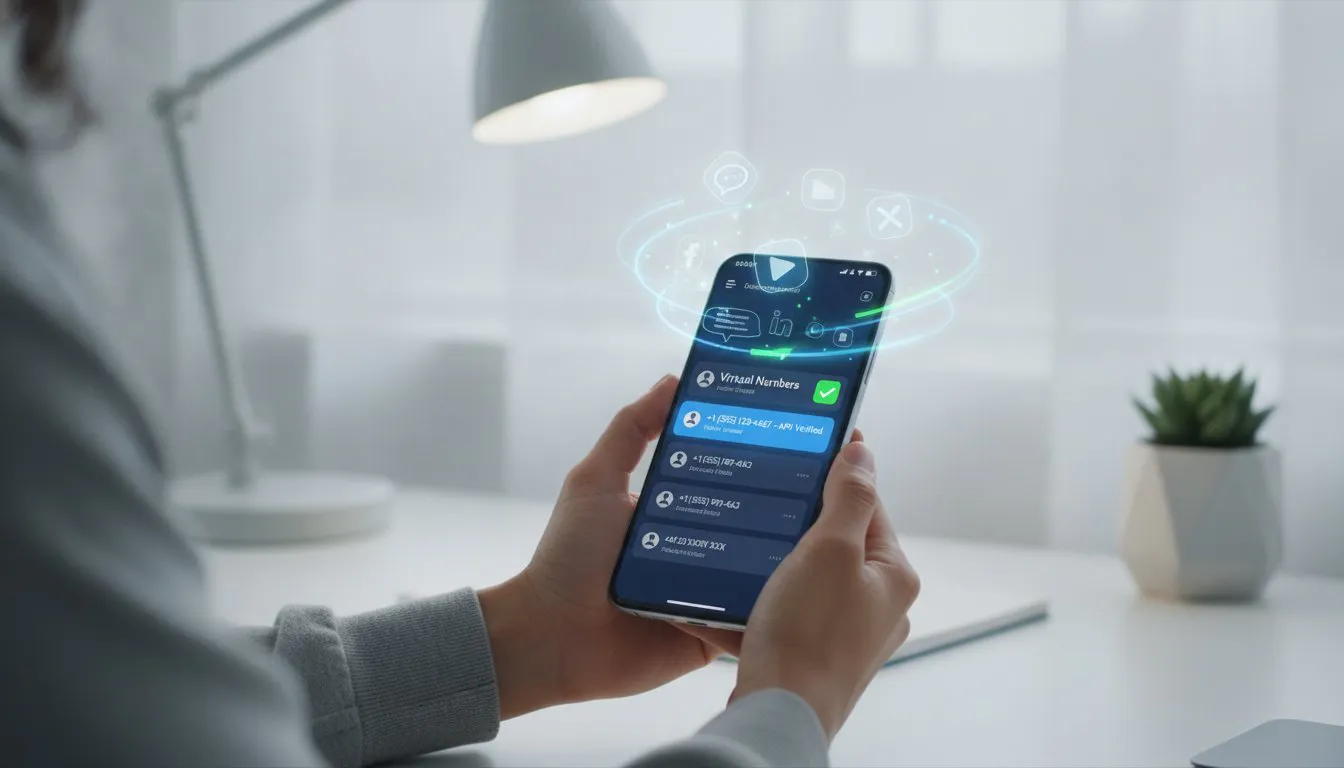
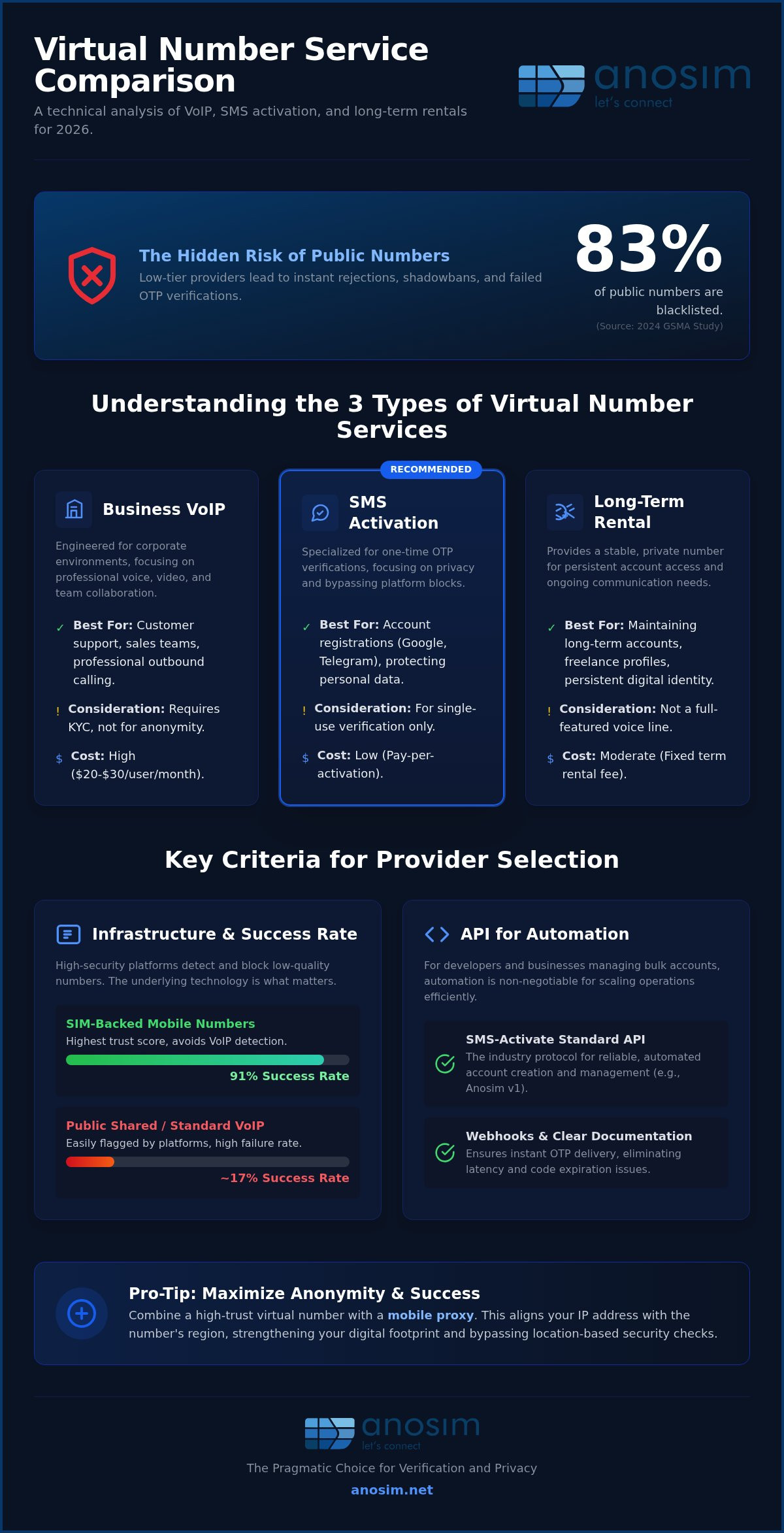
A 2024 GSMA study revealed that 83% of blacklisted phone numbers on major platforms originated from public, shared-number websites. If you've ever had an account registration on Google or Telegram instantly rejected, you've experienced the limitations of low-tier infrastructure. Choosing the wrong provider often leads to shadowbans or high failure rates for critical OTP verifications. This virtual number service comparison cuts through the marketing fluff to analyze the technical differences between business VoIP, SMS activation, and long-term privacy rentals in 2026.
You likely value reliability and data security over "free" services that often sell your information or fail during urgent tasks. We promise a deep dive into provider capabilities, focusing on API support for automated workflows and high-trust mobile infrastructure. This guide covers everything from scalable business automation to protecting your personal data from leaks. We'll examine how to find a provider that offers stable integration for your specific verification or privacy goals without the risk of platform rejection.
Key Takeaways
- Distinguish between business VoIP systems and specialized SMS activation services to ensure your provider matches your specific verification requirements.
- Use this virtual number service comparison to evaluate success rates for high-security platforms and avoid providers that are frequently blacklisted.
- Identify infrastructure that supports the Anosim API (v1) or SMS-Activate Standard API for reliable, automated bulk verification workflows.
- Select the appropriate service duration by choosing between one-time SMS activations for OTPs or long-term rent services for persistent account access.
- Optimize your digital operations by combining mobile proxies with high-trust mobile VoIP numbers to maintain anonymity and operational efficiency.
Table of Contents
- Understanding the 3 Types of Virtual Number Services
- Key Criteria for Comparing Virtual Number Providers
- Service Comparison: Features, Security, and Use Cases
- How to Choose Based on Your Specific Platform
- Anosim: The Pragmatic Choice for Verification and Privacy
Understanding the 3 Types of Virtual Number Services
Most online guides conflate all digital telephony into a single category, but a meaningful virtual number service comparison requires distinguishing between infrastructure types. To understand what is a virtual number in the current landscape, you must categorize services by their primary utility: voice communication, one-time verification, or persistent digital identity. Choosing the wrong type often results in unnecessary monthly overhead or, worse, immediate account suspension by platform security filters.
Business VoIP systems, such as RingCentral or Nextiva, are engineered for corporate environments. These platforms prioritize high-fidelity voice calls, video conferencing, and team collaboration. While they offer robust features, they typically require extensive identity verification and carry higher subscription costs, with some plans starting around $20 to $30 per user monthly. If your goal is internal team coordination or customer support, this is the standard choice.
Conversely, specialized tools like SMS Activation services and long-term rentals focus on inbound data and privacy. These services provide the infrastructure needed to bypass verification walls on platforms like Telegram, Tinder, or Google. For developers and privacy-conscious users, the priority is not making calls but securing a high-trust mobile number that can receive an OTP without being flagged as a "disposable" or "VOIP" number by automated fraud detection systems.
When to choose Business VoIP
Select a Business VoIP provider if your operation relies on outbound professional calling and multi-channel support. These services are essential for establishing a local presence for a sales team or managing a customer service desk. Because these providers comply with A2P 10DLC regulations and carrier requirements, they are the most stable option for legitimate business messaging. However, be prepared for a rigorous Know Your Customer (KYC) process; these platforms are not designed for anonymity and will link your digital identity to your billing information.
If you need to scale account creation or protect your personal data from leaks, specialized activation and rent service options are more efficient. These are the preferred tools for users who need to verify accounts on platforms that aggressively block standard VoIP numbers. In the first quarter of 2026, SIM-backed virtual numbers showed a 91% success rate for OTP delivery on major platforms, significantly outperforming public shared numbers. If you require a number for a single sign-up, a one-time activation is cost-effective. For ongoing access to an account, a rent number provides the necessary long-term stability without the high price tag of a corporate VoIP suite.
Key Criteria for Comparing Virtual Number Providers
While setup time is a common metric in surface-level reviews, a technical virtual number service comparison must prioritize success rates and infrastructure quality. High-security platforms like Tinder, Google, and Telegram use sophisticated fingerprinting to detect "dirty" number ranges. If a provider recycles numbers too quickly, your registration attempt will likely fail before it begins. Success in 2026 depends on accessing clean, private number pools rather than relying on public, shared databases.
You should also evaluate number diversity and origin. Understanding how a virtual phone number works across different carrier types is essential for passing automated checks. Providers offering mobile VoIP infrastructure often have higher trust scores than those relying on standard landline-based virtual numbers, which platform firewalls easily identify and block. Integrating mobile proxies with your number selection further strengthens your digital footprint by aligning your IP location with your number's region.
API Compatibility for Automated Workflows
Developers managing bulk accounts prioritize automation via the SMS-Activate Standard API. This protocol allows for seamless integration with registration bots and account management software. Retrieving inbound SMS programmatically ensures you receive verification codes within seconds, which eliminates the latency that often causes OTPs to expire. Reliable documentation and technical support are non-negotiable when you need to scale these operations without manual intervention. Clear API versioning, such as the Anosim v1 documentation, provides the stability required for enterprise-level deployment.
The Importance of Number Trust Scores
Not all virtual numbers are equal. Free or low-cost services typically use public ranges that platforms have already blacklisted. In contrast, premium mobile VoIP rentals utilize private pools with established reputations. Platforms monitor the ratio of successful registrations to bans for specific number blocks to determine their trust score. Dedicated numbers significantly reduce account ban risks by providing a unique, high-trust digital footprint. For users requiring the highest level of security, matching a Rent Mobile VoIP selection with a mobile proxy provides a layered defense against detection. Statistics from early 2026 show that SIM-backed virtual numbers maintain a 91% success rate for OTP delivery on the top 10 most-requested platforms, proving that infrastructure quality is the primary driver of reliability.
Privacy infrastructure is the final differentiator in a professional setup. Mobile proxies from Anosim partner proxied.com allow you to synchronize your connection data with your virtual identity. When your number and IP address originate from the same mobile carrier network, the trust score of your session increases dramatically. This alignment is critical for bypassing the strict verification filters used by major global platforms.
Service Comparison: Features, Security, and Use Cases
A technical virtual number service comparison must evaluate the underlying security protocols and data retention policies. While standard VoIP providers often store extensive metadata and require identity verification, privacy-focused services emphasize anonymity and minimal data logging. This distinction is critical for users managing digital footprints or scaling automated workflows. Global coverage also plays a decisive role; a provider's ability to offer regional numbers across multiple continents ensures that your digital presence matches your operational requirements.
Security features such as the ability to wipe data after use are standard for high-trust providers. In 2026, the global VoIP market is estimated to reach $195.39 billion, yet the most secure segments are those that decouple personal identity from telecommunications. When matching a service to a use case, consider the sensitivity of the platform. Social media bypass requires high anonymity, whereas professional account management demands stability and long-term access. Evaluating the provider's infrastructure for inbound-only SMS ensures that your data isn't exposed to the risks associated with outgoing communication channels.
Disposable vs. Dedicated Virtual Numbers
Your choice between a disposable and a dedicated number depends on your required duration. Disposable numbers are the most efficient solution for one-off verifications where you don't intend to access the account again. However, platforms like Telegram or WhatsApp often require re-verification if you log in from a new device. In these scenarios, a Dedicated Virtual Number for SMS is essential. Having a persistent number ensures you don't lose access to your account during security audits or device migrations. It's a pragmatic choice for users who value continuity over the lowest possible cost.
Mobile Proxies: The Hidden Comparison Factor
Successful digital operations often require a Mobile Proxy to complement the virtual number. Platforms monitor the relationship between your IP address and your phone number's country of origin. If you use a US number with a European data center IP, security filters will likely flag the session as suspicious. By routing traffic through mobile networks, you mimic the behavior of a real mobile user, which significantly increases account stability. This alignment is a primary differentiator when comparing the success rates of different providers.
- Rotating Mobile Proxies: Best for high-volume account creation where each session requires a unique IP address.
- Static Mobile Proxies: Ideal for maintaining long-term accounts that require a consistent connection identity.
Matching your proxy type to your number rental ensures that your digital footprint remains cohesive and trustworthy across global networks. This layered approach is the standard for professional-grade privacy and operational efficiency.
How to Choose Based on Your Specific Platform
Selecting the right provider requires a methodical assessment of the target platform's security filters. A standard virtual number service comparison often overlooks that a number working for a niche forum will likely fail on a major tech platform. High-security apps use device fingerprinting and carrier identification to block standard VoIP ranges. To avoid immediate account suspension, you must match the provider's infrastructure to the platform's specific verification strictness.
Follow these steps to determine the appropriate service for your task:
- Step 1: Evaluate platform strictness. Google and Telegram utilize advanced carrier detection to block standard VoIP ranges. If the platform is known for aggressive filtering, prioritize premium mobile infrastructure.
- Step 2: Assess duration requirements. If you only need a one-time activation, a single-use number is efficient. If the platform requires periodic re-authentication or security audits, a long-term rental is mandatory to prevent account loss.
- Step 3: Check for API compatibility. For users managing more than five accounts, manual verification is a bottleneck. Automated workflows require robust documentation and stable endpoints like the Anosim v1 API.
- Step 4: Prioritize mobile VoIP infrastructure. Numbers that appear as genuine mobile devices to the carrier network have the highest trust scores. These are far less likely to be blacklisted than server-generated numbers.
Bypassing Strict Verification Walls
High-security applications require specific strategies for bypassing Tinder phone verification and other hurdles. Platforms maintain extensive databases of blacklisted ranges associated with low-quality or "free" providers. Success depends on finding 'clean' ranges that haven't been flagged by automated fraud detection systems. Using numbers that appear as genuine mobile devices to the carrier ensures your registration request looks like a standard user session rather than a bot attempt.
Privacy-First Signups
Using a temporary phone number is a pragmatic way to minimize your digital footprint. It prevents your primary contact information from being compromised in data leaks or sold to third-party advertisers. Separating your primary identity from secondary app accounts is a critical step for modern digital security. Use this checklist for secure account creation:
- Verify the number is recognized as a mobile carrier line rather than a landline.
- Ensure the provider supports inbound SMS only to maintain maximum privacy.
- Align your IP address with the number's geographic region using a mobile proxy.
- Confirm the provider offers dedicated access to the number during the rental period.
If you need a reliable solution for high-security platform access, rent high-trust mobile VoIP numbers to ensure your accounts stay active and secure.
Anosim: The Pragmatic Choice for Verification and Privacy
While large corporate VoIP brands focus on office collaboration and hardware integration, they often fail the specific requirements of digital privacy and account verification. A technical virtual number service comparison reveals that these enterprise tools are frequently over-engineered and over-priced for users who simply need to bypass verification walls or manage bulk accounts. Anosim fills this gap by specializing in high-trust mobile VoIP infrastructure and inbound-only SMS services. By stripping away unnecessary features like outgoing calls and physical hardware, the platform provides a lean, efficient toolset designed for digital anonymity and operational scaling.
Success in 2026 relies on infrastructure that mimics real-world usage. Anosim's worldwide coverage allows you to establish a digital presence in global markets without the logistical burden of physical SIM cards. This focus on high-trust mobile ranges ensures that your accounts remain active on platforms with the strictest security filters. When combined with mobile proxies from Anosim partner proxied.com, the setup forms a complete privacy stack that synchronizes your IP data with your virtual number's carrier origin, maximizing your trust score across the web.
Built for Developers and Professionals
Automation is the standard for modern digital operations. The Anosim API simplifies bulk verification tasks by providing stable endpoints and clear documentation. Because the platform is compatible with the SMS-Activate Standard API protocol, you can integrate it into existing registration bots and account management software without rewriting your codebase. This developer-ready infrastructure ensures high-speed code delivery for time-sensitive OTPs, which is critical when managing high-volume workflows where every second counts.
- Standard Protocol Compatibility: Seamlessly switch from lower-quality providers to Anosim's high-trust ranges using existing API integrations.
- Scalable Architecture: Manage hundreds of concurrent activations or long-term rentals through a single interface.
- Reliable Delivery: Access carrier-issued numbers on physical SIM cards instead of public, shared ranges.
Security and Operational Efficiency
Operational security is enhanced by Anosim's focus on inbound-only communication. By removing outgoing SMS and voice capabilities, the service minimizes the data footprint associated with your virtual identity. This approach understands the specific needs of the privacy niche, where the goal is to receive data securely rather than establish a two-way communication channel. Whether you are protecting your personal data from leaks or scaling a professional agency, this pragmatic infrastructure offers the stability you need without the risks of traditional telephony.
Maintaining anonymity doesn't have to be complex or expensive. If you are ready to secure your digital footprint with a provider that prioritizes technical robustness and discretion, start your first SMS activation now. By choosing a partner that understands the mechanics of verification and privacy, you ensure your online operations remain both efficient and undetectable.
Securing Your Digital Identity in 2026
This virtual number service comparison has demonstrated that infrastructure quality and API reliability are the primary drivers of success for modern digital operations. Passing strict verification walls requires more than just a random number. It demands a layered approach involving high-trust mobile VoIP and mobile proxies. Whether you're scaling a professional business or protecting your personal privacy, the technical foundation you choose determines your long-term account stability and operational efficiency.
Anosim provides the necessary tools for developers and privacy seekers who value results over marketing fluff. With infrastructure that is both API v1 and SMS-Activate compatible, you can automate your workflows with quiet confidence. The platform offers carrier-issued numbers on physical SIM cards and close to 500 services across around 50 countries. This ensures you have the right tools for any verification task. It's time to move beyond public, shared numbers and invest in a professional-grade solution that respects your data.
Secure your first virtual number with Anosim today. You have the technical knowledge to navigate the evolving digital landscape; now you just need the right facilitator to support your tasks.
Frequently Asked Questions
Are virtual number services safe to use for banking?
Virtual numbers are generally not recommended for primary banking accounts because financial institutions often utilize advanced carrier detection to block VoIP and non-mobile ranges. While these services provide high-trust mobile infrastructure for app signups, banks frequently require numbers tied to a verified physical identity for regulatory compliance. Using a temporary number for banking could result in permanent account lockout if you lose access to the verification method during a security audit.
Can I use a virtual number for WhatsApp or Telegram verification?
You can use specialized virtual numbers for WhatsApp or Telegram verification. These platforms have strict filters, so success depends on using high-trust mobile VoIP infrastructure rather than public shared numbers. Choosing a dedicated rent service ensures you maintain access to the number for future re-verifications. This approach is a core part of a virtual number service comparison for users seeking to protect their primary phone number from data leaks and platform restrictions.
What is the difference between a virtual number and a VoIP number?
A virtual number is any phone number not tied to a physical telephone line, whereas VoIP is the specific technology used to transmit that data over the internet. In a technical virtual number service comparison, you'll find that some virtual numbers are landline-based, while others utilize mobile VoIP infrastructure. Mobile VoIP is often preferred for verification tasks because it carries higher trust scores with major online platforms that block standard server-generated numbers.
How much does a virtual number service typically cost in 2026?
Typical costs in 2026 vary significantly based on the service category. Business VoIP systems designed for team collaboration often start between $15 and $30 per user monthly according to current market data. Specialized SMS activation services and long-term rentals are generally more cost-efficient for developers and privacy seekers because they focus exclusively on inbound data. Prices are determined by factors like the number's country of origin, the target platform, and the required duration of the rental.
Why do some platforms reject virtual phone numbers?
Platforms reject virtual numbers to mitigate automated bot registrations and fraudulent activity. Security filters check the number's reputation and category to see if it originates from a known VoIP provider or a public shared-number database. A 2024 GSMA study found that 83% of blacklisted numbers came from public sites. Using premium, private mobile infrastructure helps bypass these filters by making the virtual number appear as a genuine mobile device rather than a server-side script.
Can I receive SMS from any country with a virtual number?
You can receive SMS from virtually any country provided your service provider offers global coverage. Anosim supports activations and rentals across a wide range of international regions, allowing you to manage accounts worldwide without physical SIM cards. However, you must ensure your IP address matches the number's country of origin using a mobile proxy. This alignment is critical for passing the geographic verification checks used by most global digital platforms to prevent unauthorized access.
How do I integrate a virtual number service into my own app?
Integration is typically handled through specialized APIs that allow your software to request numbers and retrieve SMS codes programmatically. Developers can leverage the Anosim API (v1) or the SMS-Activate Standard API to automate bulk verification tasks. These protocols provide stable endpoints for requesting activations or managing long-term rentals. Retrieving inbound SMS programmatically ensures your application receives verification codes within seconds, which is essential for maintaining high-speed, automated registration workflows without the need for manual intervention.