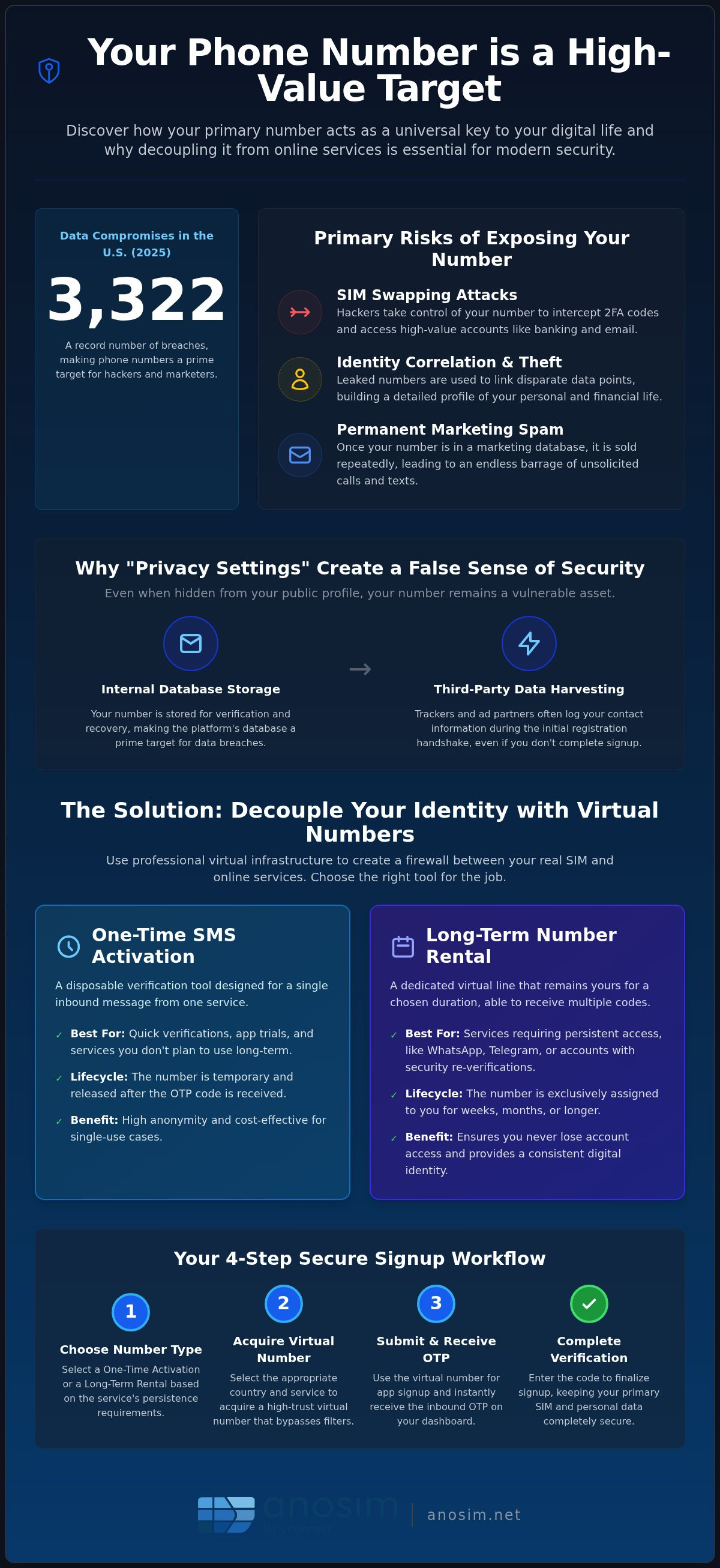
With a record 3,322 data compromises reported in the U.S. during 2025, your personal phone number has become a high-value target for hackers and marketers. It's no longer just a way to contact friends; it's a digital anchor that links your bank accounts, social media, and private communications. You likely feel the weight of this exposure every time a new app demands your digits for verification. Learning how to hide your phone number when signing up for services is the only way to break this link and protect yourself from the rising threat of SIM swapping and constant marketing spam.
This guide provides the technical framework to decouple your permanent identity from transient digital requirements. We'll show you how to build a privacy firewall using professional virtual number infrastructure, ensuring you can pass OTP verifications without exposing your primary SIM. You'll learn the differences between one-time SMS activations and long-term rentals, along with how 2026 FCC regulations on VoIP providers impact your choice of tools. By the end of this article, you'll have a clear strategy for maintaining a spam-free primary inbox while keeping your personal data secure.
Key Takeaways
- Understand why your primary phone number acts as a universal identifier and how decoupling it from online services prevents SIM swapping and identity theft.
- Identify the operational differences between one-time SMS Activation for quick verifications and long-term Rent Number services for persistent account access.
- Learn how to hide your phone number when signing up for services by using professional virtual infrastructure that bypasses the security filters often triggered by consumer burner apps.
- Follow a technical workflow for secure app signups, including selecting appropriate regional country codes and ensuring successful inbound OTP delivery.
- Scale your privacy efforts using the Anosim API (v1) to automate the acquisition of high-trust virtual numbers for enterprise-level operational efficiency.
Table of Contents
- The Risks of Using Your Primary Phone Number for Digital Signups
- Virtual Number Solutions: SMS Activations vs. Long-Term Rentals
- Comparing Methods to Shield Your Identity in 2026
- A Step-by-Step Strategy for Secure App Signups
- Leveraging Anosim for Enterprise-Grade Privacy Infrastructure
The Risks of Using Your Primary Phone Number for Digital Signups
Your phone number is no longer just a communication tool. It functions as a universal identifier that links your digital identity to banking, government portals, and credit records. When you provide this number to every minor app or discount site, you're handing over a persistent key to your personal life. Data leaks at minor platforms often expose this primary number to sophisticated actors who use it to correlate disparate data points. Marketing spam is the most immediate consequence of this over-sharing. Once your number enters a database, it's sold to brokers, leading to a permanent influx of unsolicited calls and texts. Learning how to hide your phone number when signing up for services is a necessary technical requirement for anyone concerned with modern digital security. Understanding how to hide your phone number when signing up for services is the first line of defense against these automated threats.
Why 'Privacy Settings' Aren't Enough
Most platforms offer privacy toggles to hide your number from public view. This creates a false sense of security. Even if your profile is private, the service still stores your number in its internal database for verification and account recovery. These databases remain prime targets for breaches. Additionally, third-party trackers often harvest your contact information during the initial registration handshake. Unlike a traditional unlisted phone number that simply stays out of a phone book, a digital identifier is cached across multiple servers and shared with advertising partners before you even click "accept." These handshake protocols ensure your data is logged even if you never finish setting up the account.
The Rise of SIM Swapping and Social Engineering
A leaked phone number is often the first step in a SIM swapping attack. In this scenario, a hacker convinces a mobile carrier to port your number to a device they control. Once they have control, they can intercept SMS-based two-factor authentication (2FA) codes. This allows them to reset passwords on high-value accounts like cryptocurrency exchanges or primary email addresses. Because many services treat the phone number as a trusted anchor of identity, losing control of your SIM means losing control of your entire digital footprint. Your primary SIM should be reserved for essential, high-trust services only. For everything else, you need a decoupled strategy that keeps your real identity separate from the platform's requirements. This protects you from social engineering attempts that target your mobile provider's customer service representatives.
Virtual Number Solutions: SMS Activations vs. Long-Term Rentals
Decoupling your personal SIM from digital platforms requires selecting the right virtual infrastructure. Unlike a standard phone line, virtual numbers operate through cloud-based gateways. These allow you to receive inbound verification codes without a physical device. Choosing between a temporary activation and a long-term rental depends entirely on your intended account lifecycle. Efficiency is the goal. You must match the tool to the specific persistence requirements of the service you're joining.
When to Use One-Time SMS Activations
An SMS activation is a disposable verification tool designed for a single inbound message. It's the most efficient method for users looking for how to hide your phone number when signing up for services that don't require ongoing access. For example, if you're bypassing Tinder phone verification or testing a new app trial, a one-time number is sufficient. Once the code is received and the account is verified, the number is released. This is a cost-effective way to maintain anonymity for services you don't plan to use long-term. If you only need a quick code, you can use an SMS Activation to secure your account instantly.
The Case for Dedicated Virtual Number Rentals
Some platforms require persistent access to your phone number for security checks or re-logins. Messaging apps like Telegram or WhatsApp often trigger verification requests when you switch devices or clear your cache. In these scenarios, a temporary number will lead to a locked account. A Anosim Rent Number provides a dedicated virtual line that stays assigned to you for a chosen duration. This ensures you can receive recurring codes whenever the service demands them. Renting a number also provides a consistent digital identity that isn't tied to your physical location, which is critical for managing international accounts. Security is maintained through continuity.
For more complex requirements, Rent Mobile VoIP services offer cloud-based numbers that behave like physical SIM cards for all inbound traffic. These are useful when dealing with high-security platforms that flag standard VoIP ranges. Using a mobile-originated number increases the trust score of your account. It's a key strategy for anyone researching how to hide your phone number when signing up for services while maintaining a high success rate for OTP delivery. Your choice should align with whether you need a single handshake or a permanent digital firewall. Reliability is the priority.
Comparing Methods to Shield Your Identity in 2026
Selecting a method to shield your identity requires a balance between technical reliability and operational cost. While many users initially turn to burner apps found in mobile app stores, these often rely on recycled VoIP ranges that modern platforms easily detect. If a service identifies a number as coming from a low-trust virtual provider, it may reject the signup or immediately flag the account for manual review. Professional virtual numbers solve this by utilizing mobile network infrastructure that mimics a physical SIM card's behavior. For those seeking how to hide your phone number when signing up for services, understanding the hierarchy of these tools is critical for long-term account stability.
Secondary physical SIM cards offer high security but come with significant friction. They require dedicated hardware, physical maintenance, and often involve recurring monthly fees regardless of usage. In contrast, professional virtual infrastructure provides the same high-trust signaling without the logistical burden of managing multiple physical devices. This approach allows you to scale your privacy efforts across hundreds of services while keeping your primary SIM completely isolated from the digital handshake.
VoIP vs. Mobile Network Numbers
The technical reason some services reject virtual numbers lies in the numbering resource's classification. Standard VoIP numbers are often categorized as "non-fixed," which platforms associate with automated bots and spam. High-trust numbers originate from reputable mobile network operators and carry the same metadata as a standard consumer line. Anosim ensures reliability by providing SMS Activation services that utilize these high-trust mobile ranges. This infrastructure ensures that when you're looking for how to hide your phone number when signing up for services, your virtual number passes the initial security filter of the most restrictive apps.
Enhancing Privacy with Mobile Proxies
A phone number is only one half of your digital footprint. If you use a secure virtual number but register the account from a static data center IP, the service will likely shadow-ban your profile. Routing your verification traffic through mobile proxies from our partner proxied.com allows you to mimic the behavior of a real mobile user on a cellular network. This prevents platforms from linking multiple accounts to a single location or flagging your registration as suspicious. For a deeper look at this infrastructure, see our companion article, Mobile Proxy: The Technical Guide. Combining mobile proxies with virtual numbers creates a complete privacy firewall that protects both your identity and your operational access.
A Step-by-Step Strategy for Secure App Signups
Securing a digital presence requires a methodical approach that goes beyond simply finding a temporary number. It starts with environment isolation. If you use a browser with existing cookies or a data center IP, the service will likely flag your registration attempt as suspicious. Use a clean browser profile or a mobile proxy to mimic a legitimate user on a cellular network. Once your environment is ready, select the target service and the required country code. Acquiring a virtual number through a professional provider ensures you are using high-trust infrastructure rather than recycled public ranges. This is the core of how to hide your phone number when signing up for services effectively.
Follow this technical workflow for the best results:
- Identify platform requirements: Some apps require numbers from specific regions to unlock localized features.
- Acquire the virtual number: Use the Anosim dashboard to select a number compatible with your target app.
- Input the number: Enter the virtual digits into the app's registration field while your mobile proxy is active.
- Monitor for the OTP: Watch the web dashboard or use the API to receive the inbound verification code.
- Finalize registration: Input the code immediately to prevent the session from timing out.
Bypassing Verification Hurdles
You might occasionally encounter a message stating a number is already in use. This happens when a previous user registered an account but failed to secure it, or if the carrier recycled the number recently. If this occurs, cancel the activation and request a fresh number immediately. Timing is critical for success. Most one-time activations remain active for a 15 to 20 minute window. If the code doesn't arrive within the first three minutes, the platform's gateway might be filtering the request. For specific troubleshooting steps, refer to our technical guide on How to Receive SMS Online.
Hardening Your New Account
Successful verification is only the entry point. Once you have access, immediately navigate to the security settings to harden the account. Move away from SMS-based 2FA and enable Time-based One-Time Password (TOTP) methods or hardware security keys. This decouples your account security from the phone number entirely, ensuring you don't lose access if the virtual number expires. For platforms that require persistent SMS access for recovery or recurring logins, using the Anosim Rent Service allows you to maintain the same number for multiple apps over an extended period. This provides long-term protection without ever relinking your personal SIM. Start your first secure activation today.
Leveraging Anosim for Enterprise-Grade Privacy Infrastructure
Maintaining digital anonymity at scale requires more than manual intervention. For enterprise users and developers, the challenge of how to hide your phone number when signing up for services involves managing hundreds of accounts across different geographical regions simultaneously. Anosim functions as a silent partner in this process, providing the underlying infrastructure for automated identity protection. By decoupling the verification process from physical hardware, users can deploy a high-trust privacy firewall that is both scalable and reliable. This global reach allows you to access numbers from hundreds of countries through a single unified portal, ensuring your operations remain localized and secure.
Programmatic Privacy for Developers
Automation is the standard for modern digital workflows. Integrating the Anosim API (v1) into your system allows you to generate verification numbers on demand without navigating a manual dashboard. This is particularly useful for scaling bulk verification workflows during software testing or managing large-scale marketing automation. Our infrastructure is built with compatibility in mind, supporting the SMS-Activate Standard API for seamless integration with existing tools. If you're building a system that requires high-volume verification, understanding the technical nuances of these gateways is essential. For a deeper dive into these protocols, consult our SMS Activation API: 2026 Guide. This programmatic approach ensures that your strategy for how to hide your phone number when signing up for services remains efficient and repeatable.
Why Reliability Trumps Free Services
Public SMS receivers are a significant security risk. While free services may seem attractive, they operate on public numbers where every received message is visible to anyone with the URL. This means your OTP codes and account recovery details are exposed to the open web. Furthermore, these public numbers are often "burned" or blacklisted by major platforms within hours of deployment. Anosim provides a private, secure alternative where inbound SMS delivery is guaranteed for high-security platforms. We utilize professional-grade network infrastructure to ensure that your codes arrive promptly and remain confidential. When the success of your account registration depends on the quality of the number, professional infrastructure is a necessity rather than an option. Protect your identity with Anosim today.
Protecting Your Digital Identity in 2026
Maintaining digital privacy requires a proactive shift from traditional habits to technical solutions. You've learned that your primary SIM is a high-value anchor that should be isolated from non-essential platforms. By decoupling your identity through SMS activations or long-term rentals, you eliminate the risks of data leaks and persistent marketing spam. The most effective strategy for how to hide your phone number when signing up for services is to utilize professional mobile-originated numbers rather than recycled VoIP ranges that apps often block.
Anosim provides the necessary framework for this transition. Whether you're an individual seeking a one-time verification or a developer integrating our API v1 for automated workflows, our global number coverage ensures reliable inbound SMS delivery across hundreds of countries. This pragmatic privacy infrastructure allows you to navigate the digital world without leaving a permanent trail of personal data behind. It's an essential tool for maintaining operational efficiency and security.
It's time to build your own privacy firewall. Secure your digital identity with Anosim virtual numbers and regain control over your personal information. You now have the technical strategy and the tools to stay anonymous in an increasingly connected landscape. Start protecting your data today.
Frequently Asked Questions
Is it legal to use a virtual phone number for app verification?
Using a virtual number for verification is legal in most jurisdictions. It's a pragmatic step to protect your digital identity from leaks and marketing spam. Most online services permit these numbers, although some have strict internal filters against recycled VoIP ranges. Using a professional service ensures you remain compliant with local laws while exercising your right to privacy. It's a standard tool for developers and security professionals alike.
Can I use a temporary phone number for WhatsApp or Telegram?
You can use a virtual number for these platforms, but a long-term rental is highly recommended. Messaging apps like Telegram and WhatsApp frequently require re-verification when you switch devices or clear app data. If you use a one-time SMS activation, you'll lose access to your account if a new code is requested. A dedicated Rent Number service provides the persistent access needed to keep your messaging accounts secure and accessible.
Why do some apps block my virtual number?
Apps often block virtual numbers if they identify them as low-trust VoIP ranges. Many free services use public numbers that have been flagged for spam or automated bot activity. To avoid this, you should use high-quality mobile network infrastructure that carries the same metadata as a physical SIM. This is the most reliable way to understand how to hide your phone number when signing up for services without triggering security blocks.
What is the difference between a VoIP number and a mobile number?
The primary difference lies in the trust score assigned by service providers. VoIP numbers are cloud-based and often categorized as "non-fixed," making them easier for apps to flag. Mobile numbers, like those provided through Rent Mobile VoIP, originate from cellular network carriers. These numbers behave exactly like a physical SIM card during the verification handshake, which significantly increases the success rate for inbound SMS delivery on restrictive platforms.
How long can I keep a rented virtual number?
The duration depends on the specific service you select. One-time SMS activations expire after about 20 minutes, which is ideal for quick signups. However, if you need ongoing access, the Rent Service or Rent Number options allow you to keep a line for days, weeks, or even months. This flexibility ensures you can match the rental period to the lifecycle of the account you're creating or managing.
Can I receive multiple SMS codes on the same temporary number?
Yes, you can receive multiple codes if you choose a rental service instead of a one-time activation. While a standard SMS activation is designed for a single verification event, the Rent Service allows you to receive multiple messages from a specific platform for a set duration. If you need to verify several different apps using the same digits, a full Rent Number provides a dedicated line for all inbound traffic.
Do I need a physical SIM card to use Anosim services?
You don't need a physical SIM card or any additional hardware to use Anosim. All services are managed through a web dashboard or the Anosim API (v1). This cloud-based approach allows you to acquire and manage numbers from hundreds of countries instantly. It's an efficient way to learn how to hide your phone number when signing up for services because it removes the logistical burden of physical SIM maintenance.
How do I protect my primary number if it has already been leaked?
If your primary number is leaked, you should immediately migrate your sensitive accounts to non-SMS 2FA methods like TOTP apps or security keys. Use virtual numbers for all future registrations to prevent further exposure. You can't un-leak a number, but you can neutralize its value to hackers by decoupling it from your high-value digital assets. Implementing a virtual number strategy creates a permanent firewall for your personal identity.