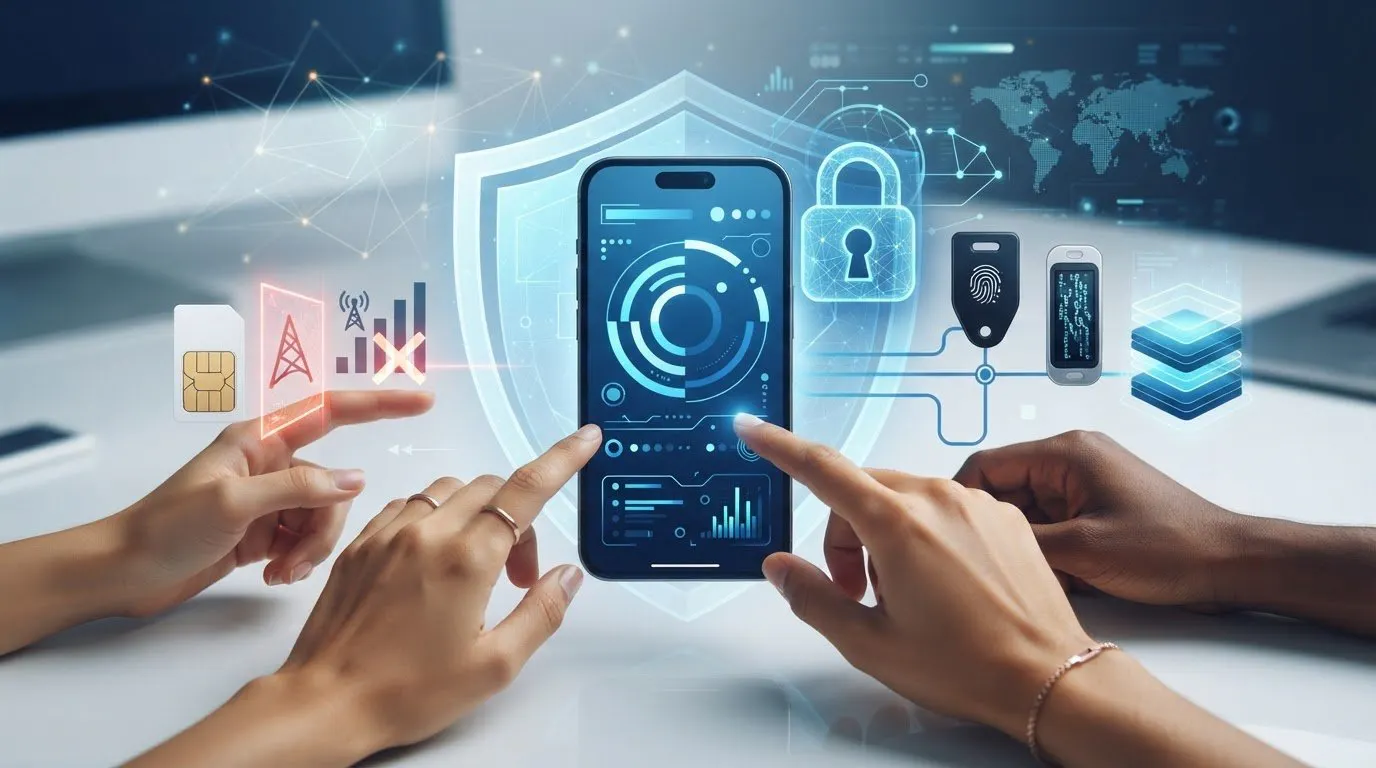
What if the number you use to protect your accounts isn’t the number an attacker needs to take over? Understanding how to prevent sim swapping with virtual numbers starts with separating two risks: exposing your primary number online and losing control of it through your mobile carrier. A virtual number can reduce how often you share your primary number, but it won’t secure your carrier account or guarantee that a service will accept it for verification.
It’s reasonable to worry about a phone-number takeover. If an attacker persuades a carrier to move your number to a SIM they control, they may receive calls and SMS recovery codes sent to that number. A separate rented number can limit where you share your primary number, but it isn’t a standalone security measure.
This guide explains what virtual numbers change, where their limits matter, and which accounts need stronger authentication. You’ll also get a practical plan for securing your carrier account, reviewing recovery settings, and responding if your mobile service suddenly stops.
Key Takeaways
- Recognize the signs of a number transfer and understand why redirected calls or texts can put account recovery at risk.
- Compare a carrier number, a virtual number, and non-SMS authentication to choose the right option for each account.
- Use this checklist for how to prevent sim swapping with virtual numbers, including strengthening carrier access and updating recovery settings.
- Prioritize email, financial, and other sensitive accounts for stronger authentication methods where available.
- Choose a number you can reliably retain for essential account recovery, and use a separate number for suitable signups.
Table of Contents
- What SIM swapping is, and why protecting your number matters
- How SIM-swap attacks work and where phone-number exposure fits
- Can virtual numbers prevent SIM swapping? What they can and cannot do
- How to reduce SIM-swap risk: a practical account-security checklist
- Choose a number strategy that limits exposure without creating a recovery gap
What SIM swapping is, and why protecting your number matters
A SIM swap is the unauthorized transfer of a mobile number to a SIM or eSIM controlled by someone else, giving that person control over calls and texts sent to the number. It isn’t the same as losing a phone or moving your number to a replacement device yourself. The risk is that someone else may receive messages intended for you, including verification codes and account-recovery messages.
A virtual number can help reduce how often you share your primary number during suitable signups. It doesn’t stop an attacker from targeting the separate number attached to your mobile carrier account. A separate number can limit exposure, while protecting a carrier-linked number requires security measures at the carrier and account level.
How a SIM swap can expose accounts
Some services send one-time passcodes or recovery links by SMS. If an attacker takes control of the number associated with an account, they may receive those messages and try to use them to sign in or reset access. A takeover doesn’t automatically unlock every account. The outcome depends on each service’s authentication, recovery process, and other safeguards.
For example, an account that relies on a text code faces a different risk from one that requires an authenticator app or security key. To understand the mechanics and common risks, see this overview of the SIM swap attack. The practical step is to review which accounts still depend on your phone number for access or recovery.
SIM swapping, number porting, and ordinary phone loss
These events are related, but they aren’t interchangeable. In a SIM swap, a number is assigned to a SIM or eSIM the account holder doesn’t control. Port-out fraud involves an unauthorized movement of the number to another carrier. Ordinary phone loss means the device is missing. By itself, that doesn’t mean the number has been transferred to another person.
The terms can overlap in everyday discussion because both SIM changes and port-outs can result in someone else controlling a number. The key issue is not simply whether a phone has disappeared or stopped working, but whether calls and texts for the number are reaching a device or service you don’t control. If mobile service unexpectedly stops, contact your carrier and secure important accounts promptly.
For anyone researching how to prevent sim swapping with virtual numbers, keep the boundary clear: a virtual number may reduce disclosure of your primary number, but it isn’t a shield for a different carrier-linked number. Use it as a privacy option where an account supports it, and assess each account’s authentication and recovery setup separately.
How SIM-swap attacks work and where phone-number exposure fits
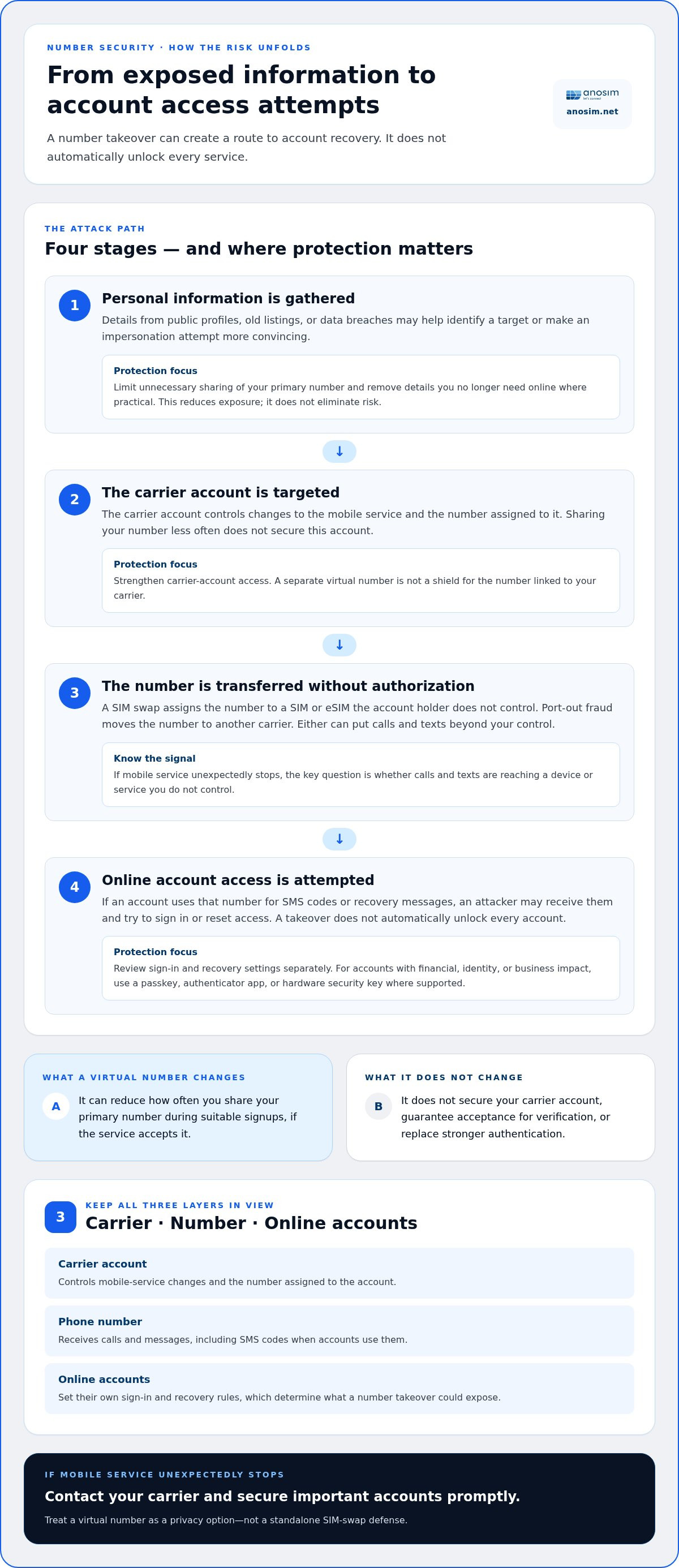
A SIM-swap attack typically moves through several broad stages: an attacker gathers personal information, targets the victim’s carrier account, obtains an unauthorized number transfer, then tries to use control of that number to access online accounts. Methods vary, and this overview avoids operational details that could enable fraud. The sequence matters because a number takeover creates a route to account attempts, not automatic access to every service.
Reducing public exposure is different from securing carrier access. Sharing your primary number less often may reduce unwanted contact and the amount of information associated with it online, but it doesn’t protect the carrier account that controls the number. For more background on how to prevent SIM swapping, Kaspersky discusses common risks and protective measures.
Three connected security layers
Think of the risk as three related layers, each needing its own protection:
- Carrier account: Controls changes to the mobile service and the number assigned to it.
- Phone number: Receives calls and messages, including SMS codes if accounts use them.
- Online accounts: Apply their own sign-in and recovery rules, which determine what a number takeover could expose.
Protecting only one layer leaves the others at risk. For example, using a separate number for a suitable signup may reduce exposure of your primary number, but it won’t secure the carrier account linked to that number.
Why SMS codes can become an account risk
SMS verification depends partly on continued control of the number receiving the code. A login second factor is different from a recovery message sent after a password reset, and both differ from notification texts that simply report account activity. Review these settings separately. For accounts with financial, identity, or business impact, use a passkey, authenticator app, or hardware security key where the service supports it, and retain recovery options you can access.
How personal information contributes to targeting
Information exposed through public profiles, old listings, or data breaches can help someone identify a target or make an impersonation attempt more convincing. A publicly visible primary number may also attract unwanted calls and messages, creating more opportunities for deceptive contact. Limit unnecessary sharing and remove details you no longer need online where practical. This reduces exposure, but doesn’t eliminate SIM-swap risk. Information may be available elsewhere, and carrier-account protections remain important.
If a service accepts a separate number for verification, a virtual number can help limit where you disclose your primary number. Treat it as privacy management, not a substitute for strong authentication or secure carrier access.
The practical aim of how to prevent sim swapping with virtual numbers is to reduce exposure without relying on the number alone. Protect the carrier account, choose stronger sign-in methods for high-impact services, and check how each account handles recovery.
Can virtual numbers prevent SIM swapping? What they can and cannot do
A separate virtual number can reduce how often you disclose your primary number, but it doesn’t prevent an attacker from targeting the carrier account tied to that primary number. Virtual numbers support number privacy for suitable signups; carrier protections and strong account authentication address different risks. No number type guarantees that an account is safe from takeover.
Primary carrier number: Your regular mobile number, managed through your carrier. It may be needed for important accounts, but sharing it broadly can expose it to more signups and unwanted contact.
Separate virtual number: A distinct number you can use for suitable verifications. It can keep your primary number private from those services, but it doesn’t secure your carrier account or guarantee acceptance by a platform.
Non-SMS authentication: Options such as an authenticator app, passkey, or hardware security key reduce reliance on text messages where an account supports them. They don’t replace a review of account recovery settings.
These options serve different purposes. A virtual number changes which number you disclose; non-SMS authentication changes how you prove access. A service may set its own rules for acceptable numbers and recovery methods, and may reject virtual or VoIP numbers. Review the account’s terms and available settings before relying on a number for ongoing access.
When a separate virtual number can help
Use a separate number for suitable signups where your personal number isn’t necessary, such as a service that accepts another number for verification. This limits where your primary number is shared; it doesn’t defeat fraud or protect a carrier account. Anosim provides virtual numbers for inbound SMS, including longer-term rentals for verification use.
Before using one, consider how long you’ll need access. If the account matters over time, plan to keep receiving verification messages and update the account’s recovery details if your number strategy changes. A number used only for an initial code may be unsuitable if the service later sends login or recovery messages to it.
When not to rely on a virtual number alone
Don’t treat any phone number as a substitute for strong authentication. For sensitive accounts, use a supported passkey, authenticator app, or security key where possible, and keep recovery options current. Losing access to a rented number could make future verification or account recovery harder, so understand each service’s accepted methods and preserve a reliable way back in.
The practical answer to how to prevent sim swapping with virtual numbers is to use a separate number for privacy where it fits, while protecting carrier access and strengthening account sign-in independently. Choose the number strategy account by account, based on its rules, sensitivity, and recovery needs.
How to reduce SIM-swap risk: a practical account-security checklist
A reliable plan protects your carrier account, strengthens sign-in for important services, and preserves a recovery route you can still access. Work through these steps, then keep a record of which number each account uses for contact, login verification, and recovery. Those roles can differ, so don’t assume one number setting covers all three.
- Secure carrier access. Set a unique password for your carrier account and limit access to its login credentials and recovery details. Ask your carrier about available account PIN, port-lock, or SIM-change protections. Options vary by carrier, and no single setting should be treated as protection against every attack.
- Prioritize accounts that unlock others. Start with your primary email, financial accounts, password manager, and any account that can reset other logins. A compromised email account, for example, may expose password-reset messages for connected services. Review these accounts before less sensitive signups.
- Replace SMS factors where possible. For high-impact accounts, choose an authenticator app, passkey, or hardware security key if the service supports it. SMS may remain an available fallback, but relying on it as the only additional sign-in factor leaves access partly dependent on control of that number.
- Audit recovery and alerts. Check each account’s recovery phone number and email address, confirm they’re current, and remove details you no longer control. Review active sessions and recent security notifications for unfamiliar access. Store backup codes securely, separate from the device or account they help recover.
Separate contact, login, and recovery details
For each important account, record whether your number is used for general contact, login codes, password recovery, or all three. A service may let you use different details for these functions. Keep a dependable recovery method for accounts you need long term, and avoid removing a working recovery route until its replacement has been tested. For suitable signups that don’t need your personal number, a virtual number rental can help separate signup contact details from your primary number. This manages exposure; it doesn’t secure the carrier account.
If mobile service suddenly stops
Don’t assume a temporary outage is a SIM swap, but treat an unexplained loss of service as a reason to act. Use another trusted channel, such as a different phone or the carrier’s official online account, to report the issue and ask whether a number or SIM change has occurred. From a trusted device, secure high-priority accounts, review sign-in activity, and update recovery details if needed. Avoid relying on the affected number to receive codes while access is uncertain.
This checklist turns how to prevent sim swapping with virtual numbers into a layered routine: harden carrier access, prioritize accounts by the damage a takeover could cause, and keep recovery methods usable. A separate number can limit primary-number exposure at appropriate signups, while account-level protections address the risks it can’t.
Choose a number strategy that limits exposure without creating a recovery gap
Choose numbers based on what each account needs, not on the assumption that one number can safely serve every purpose. A primary carrier number may be the practical choice for an account where dependable, ongoing recovery matters. A separate number can reduce how often you disclose that primary number for suitable signups. The trade-off is access: if an account depends on a number you later can’t use, verification or recovery may become difficult.
Before adding any number, review the account’s accepted authentication methods, recovery process, and rules. A virtual number won’t work where the platform rejects it or where you can’t maintain access for as long as the account requires.
Plan number use around account importance
Separate routine signup contact details from recovery for accounts that could unlock other services. For example, a number used to verify a low-impact signup doesn’t necessarily belong on your primary email or financial account. Keep critical accounts tied to recovery methods you can reliably access over time, and consider using a supported passkey, authenticator app, or security key instead of SMS. If a service requires a specific number type, follow its rules.
Make a simple account record with the service name, the number’s role, and the recovery method. Review it when you change numbers or authentication settings. This helps prevent a common planning gap: removing an old number from regular contact details but leaving it as the only recovery option.
Use a virtual number for suitable verification needs
For services that accept a separate number and don’t require your personal number, a virtual number can keep signup contact details distinct from your primary line. Anosim provides inbound SMS activation and longer-term virtual-number rentals for verification use. A long-term virtual number rental may suit a verification need that continues beyond a single signup, but it isn’t anti-fraud protection or a replacement for strong authentication.
Plan for future access before assigning a number to an account. Consider whether the service may request another code later, whether its recovery options allow you to update the number, and what you’ll do if you can no longer access it. Keep a separate, dependable recovery method for important accounts where possible. This balances reduced primary-number exposure with continued account access.
The core principle behind how to prevent sim swapping with virtual numbers is to use each number deliberately: protect the primary number’s carrier account, share it selectively, and use a separate number only where the platform and your long-term recovery plan support it. Explore Anosim virtual number rentals for verification use.
Make your next account change with confidence
Choose one important account today and check whether its recovery method will still work if your phone number changes or becomes unavailable. Set a reminder to review that information whenever you update your contact details. Small, deliberate checks can prevent a privacy choice from turning into a recovery problem later.
The useful way to think about how to prevent sim swapping with virtual numbers is as an ongoing account-management practice, not a one-time number switch. Keep each number’s purpose clear, and choose services that fit your privacy and access needs.
If a separate number suits your signup or verification needs, explore Anosim’s virtual-number options. Choose a number that fits your use case and pair it with a recovery plan you can rely on.
Frequently Asked Questions
Can SIM swapping happen without physical access to my phone?
Yes. A SIM swap targets control of your mobile number, not possession of your handset. If a transfer is made without your authorization, your phone may lose service while calls or texts for your number go elsewhere. If your phone suddenly shows no service unexpectedly, use another trusted device or channel to contact your carrier and check whether a number change occurred.
Is an eSIM immune to SIM-swapping attacks?
No. An eSIM is a digital SIM profile, but using one doesn’t make a mobile number immune to unauthorized changes. Someone may still target the carrier account or the process used to manage the number. Protect your carrier login and use available account safeguards whether your device uses a physical SIM or an eSIM.
What happens to SMS verification codes during a SIM swap?
If a number is transferred to a SIM or eSIM controlled by someone else, new SMS codes sent to that number may reach that person instead of you. Codes already delivered to your device aren’t automatically transferred. If you suspect a takeover, don’t share codes. Use a trusted device to review sign-in activity and secure accounts that rely on SMS.
Can I use a virtual number for account recovery?
Sometimes, but it depends on the service’s accepted number types and recovery rules. Before using a virtual number, check whether the account will allow it for recovery and whether you can retain access for future verification. For important accounts, keep another supported recovery method, such as a current email address or saved backup codes. This is a practical part of how to prevent sim swapping with virtual numbers.
Do carrier account PINs stop every SIM-swap attack?
No. An account PIN can add a verification layer, but it shouldn’t be treated as a guarantee against unauthorized changes. Use a unique carrier-account password, keep account recovery details protected, and ask your carrier which additional safeguards are available. If you receive an unexpected SIM-change or number-transfer notification, contact the carrier through an official channel and review important account activity.
Should I change my phone number after a suspected SIM swap?
Not automatically. First, contact your carrier through a trusted channel and ask them to help restore control of the line and address unauthorized changes. Then secure important accounts and review their recovery details. A new number may be worth considering if your current number remains at risk, but plan the transition carefully and update account contacts and recovery methods before relying on it.