In 2026, your phone number is no longer just a way to reach you; it's a permanent, exploitable link to your physical identity and financial history. Most people realize that giving out a primary number leads to annoying spam, but the actual risks of using your personal number for signups are far more severe. With FBI IC3 reports showing over $20 billion in total cybercrime losses, that quick verification for a new app can expose you to SIM swapping and identity theft. Even as NIST SP 800-63-4 deprecates SMS-based authentication, many platforms still use your number as a primary account key.
It's natural to feel uneasy about every new service demanding your mobile digits. Data privacy policies are often opaque, and once your number is indexed in a leaked database, it becomes a target for phishing. You don't have to accept this exposure as the cost of doing business online. This guide will show you why your primary phone number is a security liability and how to use virtual alternatives to prevent identity theft and data leaks.
We'll examine the specific technical vulnerabilities of phone-based identity. You'll learn actionable steps to decouple your digital footprint from your personal device using reliable SMS verification and rental tools.
Key Takeaways
- Understand why your mobile number has evolved into a digital Social Security Number and the specific risks of using your personal number for signups in an era of high-frequency data breaches.
- Learn why standard SMS-based two-factor authentication is now considered a security vulnerability and how to defend against technical threats like SIM swapping.
- Discover a multi-layered approach to auditing your digital footprint and decoupling your primary identity from low-trust applications and platforms.
- Identify the operational differences between disposable numbers for one-time verification and long-term mobile VoIP rentals for persistent account management.
- Explore how professional SMS activation services act as a secure firewall, allowing you to bypass verification hurdles while keeping your personal data offline.
Table of Contents
- The Evolution of the Phone Number: From Contact Info to Digital Super-ID
- The 4 Primary Risks of Using Your Personal Number for Online Signups
- From Account Hijacking to SIM Swapping: The Technical Threats
- How to Protect Your Privacy During App Signups: A Multi-Layered Approach
- SMS Activation and Virtual Numbers: The Professional Path to Digital Anonymity
The Evolution of the Phone Number: From Contact Info to Digital Super-ID
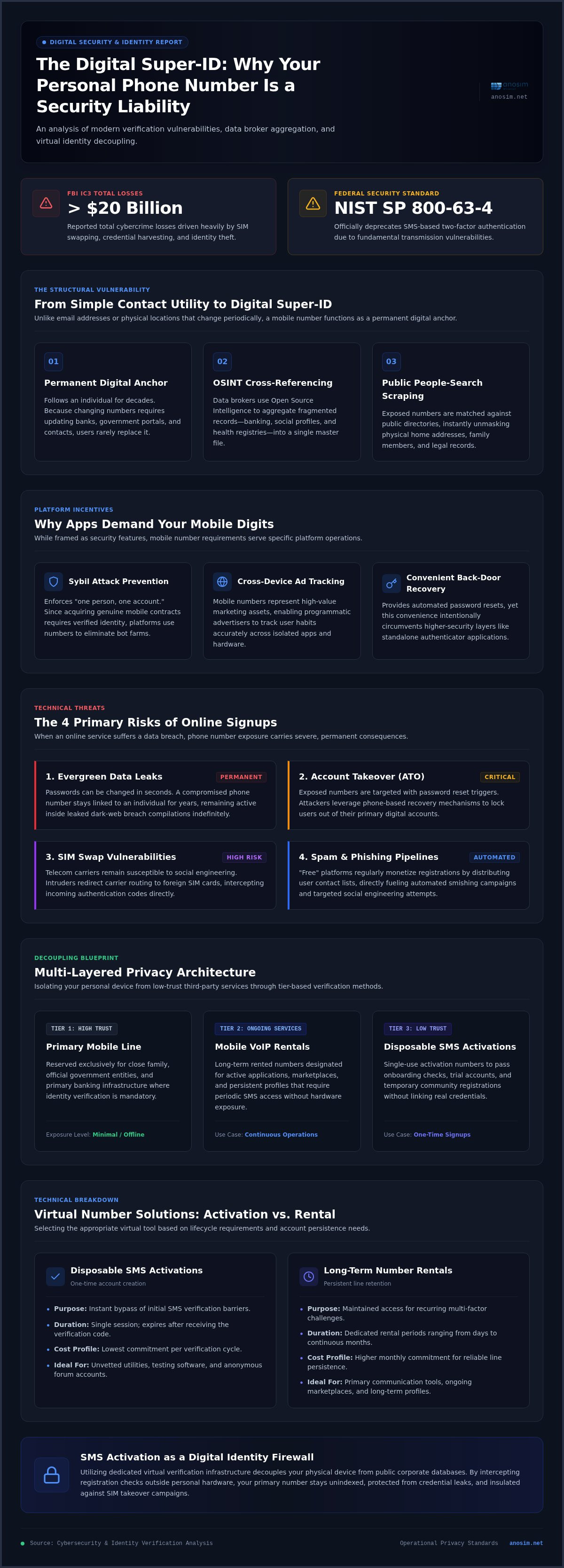
Your phone number used to be a simple utility for voice calls. Now, it functions as a digital Social Security Number. Unlike an email address that you can discard or a physical address you might leave, a mobile number often follows you for decades. This permanence makes it a goldmine for data brokers. Understanding the risks of using your personal number for signups starts with recognizing its role as a universal identifier. Data brokers use your digits to cross-reference disparate databases, a practice known as Open Source Intelligence (OSINT), to build a detailed map of your life. A phone number acts as a persistent digital anchor for identity aggregation, allowing disparate datasets to be merged into a single, comprehensive profile of an individual.
Why Apps Demand Your Number
Platforms claim they require your mobile number for security, but the motivations are often operational. The trade-off between user convenience and long-term privacy erosion is steep.
- Sybil Attack Prevention: Services use phone numbers to ensure "one person, one account." Since obtaining multiple verified mobile lines is traditionally difficult, it's an effective way to stop bot farms and duplicate accounts.
- Marketing and Tracking: A verified mobile number is a high-value asset in the advertising ecosystem. It allows companies to track your behavior across different devices and apps with high precision.
- Account Recovery: While convenient, using a number as a recovery method creates a back door that bypasses stronger security layers like authenticator apps.
The "Super-ID" Concept
The primary risks of using your personal number for signups stem from how it links your entire digital existence. In the background, your number connects your banking records, social media profiles, and even medical history. If an attacker gains access to this "Super-ID," they can execute a SIM swap attack to intercept sensitive verification codes and take over your financial accounts. Because carriers have been historically vulnerable to social engineering, your primary number is often the weakest link in your security chain.
Public "People Search" sites frequently scrape these numbers to reveal your home address, family members, and criminal records to anyone with a few dollars. While you can reset a compromised password in seconds, changing a primary phone number is a massive undertaking. It requires updating every bank, government agency, and personal contact you have. This friction is why many users opt to rent number services instead of exposing their permanent identity to every new application they test.
The 4 Primary Risks of Using Your Personal Number for Online Signups
Understanding the risks of using your personal number for signups requires looking at the technical consequences of a single data point compromise. When you provide your primary mobile digits to a service, you aren't just creating a login. You're handing over a permanent key to your digital identity. If that service is compromised, the fallout extends far beyond a simple password reset. Attackers prioritize phone numbers because they serve as a stable, verified link to a real person, making them more valuable than email addresses on the dark web.
Data Leaks and Permanent Exposure
In 2024 and 2025, major breaches across social media and financial platforms demonstrated that phone numbers are often the primary data point leaked. Unlike a password, which you can change instantly, your phone number is likely tied to your life for years. This creates "evergreen" exposure; once your number is in a leaked database, it remains a target for decade-long exploitation. You can learn more about how to avoid data leaks to stay ahead of these persistent threats. When a number is exposed, it's frequently used for account takeover (ATO) attempts, where hackers attempt to reset your passwords by intercepting the very codes you rely on for security.
The Spam and Phishing Pipeline
Many "free" signups monetize your data by selling it to third-party partners. This creates a direct pipeline to your inbox for aggressive marketing and sophisticated phishing. In 2026, the rise of AI-driven voice phishing, or vishing, has made leaked numbers even more dangerous. Attackers can now use deepfake technology to mimic trusted entities, using your leaked number to establish immediate credibility. Traditional defenses are failing; international bad actors routinely ignore "Do Not Call" registries, knowing that local regulations have little reach over global cybercrime syndicates.
Social engineering remains a top threat as attackers use leaked numbers to build trust. By knowing your number, a criminal can send a highly targeted SMS that appears to be from your bank or a delivery service. This FCC guide on port-out fraud details how these criminals use such information to commandeer accounts entirely. To mitigate these vulnerabilities, many users now opt for SMS activation services that isolate their primary identity from third-party platforms. This approach creates a necessary firewall between your personal life and the apps you use, ensuring that a single breach doesn't compromise your entire digital footprint.
From Account Hijacking to SIM Swapping: The Technical Threats
The technical risks of using your personal number for signups culminate in the threat of account takeover. SIM swapping is a specific type of fraud where an attacker convinces a mobile carrier to port your existing number to a device they control. This effectively transfers your digital identity to the hacker. Because your phone number is often the primary key for identity verification, losing control of it means losing control of your entire digital life. Attackers prioritize these attacks because they provide a direct path to high-value assets like banking and cryptocurrency wallets.
How SIM Swapping Works in 2026
Attackers don't always need advanced coding skills to hijack a line. They often rely on social engineering targeted at telecom employees. By using personal data harvested from public breaches, a criminal can impersonate you and claim they've lost their device. If you've shared your primary number on social media or professional directories, you've already made yourself a high-value target. Once the attacker controls your inbound SMS stream, they can trigger password resets across multiple platforms. The verification codes arrive on their device, allowing them to bypass traditional security measures in minutes.
The Fallacy of SMS-Based 2FA
Many users believe they are secure because they have enabled two-factor authentication. However, security experts now view SMS 2FA as the weakest link in modern security architectures. According to FTC guidance on two-factor authentication, relying on text messages for security codes is increasingly risky due to network-level vulnerabilities. Sophisticated actors can exploit the SS7 protocol, a legacy telecommunications standard, to intercept verification codes at the carrier level without ever touching your physical phone.
The most dangerous vulnerability is the "Account Recovery" loop. Even if you use a secure authenticator app for daily logins, many services allow a bypass via SMS if you click "forgot password." This creates a permanent back door into your accounts. Managed virtual tools, such as the rent number service, provide a necessary layer of abstraction. Unlike a physical SIM tied to your name and credit history, these numbers don't offer the same social engineering entry points for attackers. By using a dedicated line for verification, you ensure that your primary communication channel remains isolated from the platforms you sign up for.
How to Protect Your Privacy During App Signups: A Multi-Layered Approach
Once you recognize the technical risks of using your personal number for signups, the next step is building a resilient defense. This isn't about avoiding digital services, but about controlling the data you share with them. A multi-layered approach ensures that even if one platform suffers a breach, your primary identity remains isolated and secure. Follow these steps to decouple your personal life from your digital footprint:
- Step 1: Audit your Digital Footprint. Use identity monitoring tools to identify where your primary number is currently exposed. If your digits appear in public "People Search" databases, prioritize removing them.
- Step 2: Use disposable numbers for low-trust sites. For one-time discounts, forum access, or apps you don't intend to use long-term, choose a temporary SMS activation.
- Step 3: Rent long-term virtual numbers. For essential services like social media or professional tools, rent a mobile number that provides persistent access without the vulnerabilities of a physical SIM.
- Step 4: Implement mobile proxies. Mask your IP address with a mobile proxy, for example from our partner proxied.com, to prevent platforms from linking your virtual number to your physical location.
- Step 5: Transition to non-SMS authentication. Wherever possible, use FIDO2 hardware keys or synced passkeys. These methods remove the phone number from the security equation entirely.
Disposable vs. Long-Term Virtual Numbers
Choosing the right tool depends on the value of the account you are creating. A 10-minute SMS activation is a pragmatic choice for a quick signup where you don't need to log in again. However, if you are managing a primary account, you should rent a mobile number for ongoing access. This prevents you from being locked out if the service requires a security check six months later. The cost of these privacy tools is negligible compared to the thousands of dollars lost in an identity theft incident. It's a simple calculation of risk management.
Advanced Protection for Developers and Power Users
For those managing multiple accounts or building automated workflows, manual verification is inefficient. Using an SMS activation API allows you to integrate secure signups directly into your software. This is a critical infrastructure component for bypassing Tinder phone verification or other high-friction onboarding processes that often flag standard VoIP lines. By combining API-driven activations with mobile proxies, you maintain high account trust scores and operational efficiency without ever exposing your personal device. To start securing your digital identity, you can get an SMS activation for your next signup today.
SMS Activation and Virtual Numbers: The Professional Path to Digital Anonymity
Modern digital security requires a shift from passive protection to active infrastructure management. You shouldn't view a phone number as a permanent part of your identity, but as a modular component of your security stack. Virtual numbers function as a modern firewall for your mobile identity, absorbing the impact of data leaks and targeted attacks. The risks of using your personal number for signups are not just theoretical; they're a direct threat to your financial and social stability. By routing verification through a secure intermediary, you prevent third-party databases from ever linking your physical device to your digital profiles.
Reliability is the primary concern for professional and personal use. While free VoIP services are frequently flagged and blocked by major platforms, a professional SMS activation service provides access to high-trust mobile network pools. This is particularly critical for international platforms that implement strict regional filters. Decoupling your identity from your phone number is the single most effective privacy move you can make in 2026. It turns a permanent vulnerability into a disposable, manageable asset.
Why Anosim is the Pragmatic Choice
Anosim provides the technical infrastructure necessary for high-trust account verification. Unlike consumer-grade apps that rely on recycled internet-based lines, our service utilizes high-trust mobile network infrastructure to ensure successful verifications across global platforms. We offer extensive global coverage for international SMS activation requirements, allowing you to bypass regional restrictions without physical travel or multiple SIM cards. For developers and power users, our API v1 facilitates seamless integration. You can scale privacy-first applications by automating number orders, rentals and SMS retrieval.
Getting Started with Your Privacy Firewall
Securing your identity starts with selecting the right tool for the specific task. If you're performing a one-time registration for a low-stakes service, a quick activation is the most efficient choice. For accounts that require persistent 2FA or long-term management, a mobile VoIP rental provides the necessary stability. Account longevity also depends on your connection quality. Using mobile proxies from a provider such as our partner proxied.com to maintain clean, consistent IP addresses prevents platforms from flagging your account due to "suspicious" location data. This combination of virtual numbers and proxies creates a robust environment for digital tasks. Protect your primary number today with Anosim virtual solutions.
Take Control of Your Digital Identity
The transformation of the phone number from a simple contact tool into a digital super-identifier means every signup is a potential security breach. Relying on your primary mobile line for verification creates a permanent, exploitable link to your physical identity. This practice exposes you to sophisticated threats like SIM swapping and AI-driven vishing. By implementing a multi-layered defense strategy, you can effectively mitigate the risks of using your personal number for signups and regain control over your digital footprint.
Professional security requires reliable infrastructure. Whether you need global virtual number coverage for international platforms or API v1 integration for automated developer workflows, our tools provide a necessary firewall. Combining these virtual solutions with mobile proxies from our partner proxied.com helps maintain high-trust account stability without compromising your personal data. You don't have to accept privacy erosion as a requirement for using modern apps and services.
Secure your digital identity with Anosim SMS Activation today. It's a pragmatic, effective step toward achieving total digital anonymity and operational security.
Frequently Asked Questions
Is it illegal to use a virtual number for app signups?
Using a virtual number for signups is not illegal in most jurisdictions. It is a privacy-preserving technique that allows you to manage your digital footprint without exposing your primary device. However, you must comply with the Terms of Service of the platform you are joining. Some apps may restrict accounts that use virtual lines to prevent automated spam. It's best to use high-trust mobile network infrastructure to ensure your account remains in good standing.
Can I use a virtual number for banking or government services?
High-security institutions like banks and government agencies often implement strict filters against standard VoIP numbers. While you can attempt to use a virtual number, these platforms frequently require a line tied to a major carrier. To increase success rates, you should consider a Rent Mobile VoIP service that utilizes mobile network pools rather than fixed-line internet routing. Always maintain a backup recovery method to avoid being locked out of critical financial or legal accounts.
What is the difference between a VoIP number and a real mobile number for verification?
The primary difference lies in the underlying infrastructure and how platforms perceive the line's trust score. Standard VoIP numbers are internet-based and often flagged as "non-fixed VoIP" in carrier databases. In contrast, a real mobile number is backed by a Mobile Network Operator (MNO). Services like Anosim provide virtual access to these high-trust mobile pools, allowing you to receive verification codes that are indistinguishable from those sent to a physical SIM card.
How do I know if my personal phone number has already been leaked?
You can check if your data has been compromised by using reputable breach aggregation services like Have I Been Pwned. These tools index public data leaks and will tell you if your digits were part of a specific incident. If your number appears in these databases, the risks of using your personal number for signups increase significantly. Once leaked, your number is often sold on "sucker lists" to telemarketers and sophisticated phishing syndicates.
Will apps block me if I use a virtual number for signup?
Some platforms use carrier-level APIs to detect and block virtual numbers during the onboarding process. This is common in high-friction apps like Tinder or OpenAI. To bypass these restrictions, you need a service that offers lines from genuine mobile network ranges. Using mobile proxies alongside your virtual number can also help maintain a high trust score by ensuring your IP address matches the regional origin of the phone number being used for verification.
How long can I keep a rented virtual number for 2FA?
Rented virtual numbers can be held for varying durations depending on your specific requirements. While a standard SMS activation is designed for a single verification code, a Rent Number service allows you to maintain access for weeks or months. This is essential for services that require periodic 2FA challenges or account recovery. If you need persistent access to an important account, choose a long-term rental to ensure you don't lose your inbound SMS stream.
What should I do if my primary phone number is being targeted by SIM swappers?
If you suspect you're a target, immediately contact your mobile carrier to place a "Port-Out Block" and a secondary security PIN on your account. You should also move your most sensitive accounts away from SMS-based 2FA and toward hardware security keys. Decoupling your identity from your primary device is a critical step. Transitioning your online signups to virtual lines prevents attackers from using your primary number as a single point of failure for your entire digital life.
Can I receive SMS online without a physical SIM card?
You can receive SMS online without a physical SIM card by using virtual number infrastructure. These services route inbound text messages through the cloud directly to a web interface or an API. This allows you to manage multiple verifications from a single dashboard without needing a drawer full of physical cards. It's a pragmatic solution for developers using an SMS activation API to automate workflows or for individuals who want to maintain digital anonymity while signing up for new services.