In 2026, the secret to account longevity isn't hiding your identity; it's blending into the noise of millions of legitimate mobile users. Most professionals realize that traditional datacenter IPs are now instant red flags for sophisticated anti-fraud systems. You've likely felt the frustration of a "perfectly" configured setup failing within hours, leading to shadowbans and lost assets. If you're tired of the high cost of dedicated IPs and the complexity of managing fingerprints, you aren't alone. Transitioning to using mobile proxies for account management allows you to leverage the same infrastructure as real retail customers.
This article provides the technical framework for mastering high-value account management without triggering security alarms. We'll examine how Carrier-Grade NAT (CGNAT) functions as a trust-shield by assigning the same public IP to thousands of users, making your automated actions indistinguishable from organic traffic. You'll learn to synchronize mobile IPs with SMS verification and API-driven automation to ensure your social media or e-commerce operations scale efficiently. By the end, you'll have a stable strategy for long-term growth that minimizes the risk of linked account bans.
Key Takeaways
- Understand why mobile proxies provide a superior trust score compared to datacenter IPs by mimicking real cellular network behavior.
- Learn how Carrier-Grade NAT (CGNAT) protects your accounts from bans by sharing IP addresses among thousands of legitimate users.
- Master the process of using mobile proxies for account management by synchronizing high-trust IPs with non-VoIP SMS verification to avoid shadowbans.
- Implement safe scaling protocols by limiting account creation to one or two profiles per IP rotation to maintain a clean digital footprint.
- Discover how to integrate the Anosim API (v1) to automate SMS activations and number rentals for high-volume agency operations.
Table of Contents
- Why Mobile Proxies are Essential for Modern Account Management
- The Technical Advantage: CGNAT and High-Trust IPs
- The Account Lifecycle: From SMS Verification to Management
- Scaling Safely: How Many Accounts per Mobile Proxy?
- Automating Verification Workflows with the Anosim API
Why Mobile Proxies are Essential for Modern Account Management
Mobile proxies function as gateways that route your digital traffic through real cellular hardware connected to 4G, 5G, or LTE networks. These proxies utilize IP addresses assigned by major mobile network operators, ensuring your traffic appears as legitimate retail data. For any professional, using mobile proxies for account management has become a baseline requirement for operational security. In 2026, the technical gap between a user and a bot is often defined by the network infrastructure behind the connection.
Modern platform algorithms have evolved beyond simple IP blacklisting. They now employ deep packet inspection and infrastructure analysis to categorize traffic. Mobile IPs enjoy a unique status because of Carrier-Grade NAT (CGNAT). This technology enables mobile carriers to assign one public IP to thousands of concurrent users. Platforms cannot ban these IPs without risking significant collateral damage to their actual user base. Implementing a strategy using mobile proxies for account management allows you to bypass advanced bot detection systems on social media and e-commerce sites that would instantly block datacenter or low-quality residential traffic.
Datacenter vs. Residential vs. Mobile Proxies
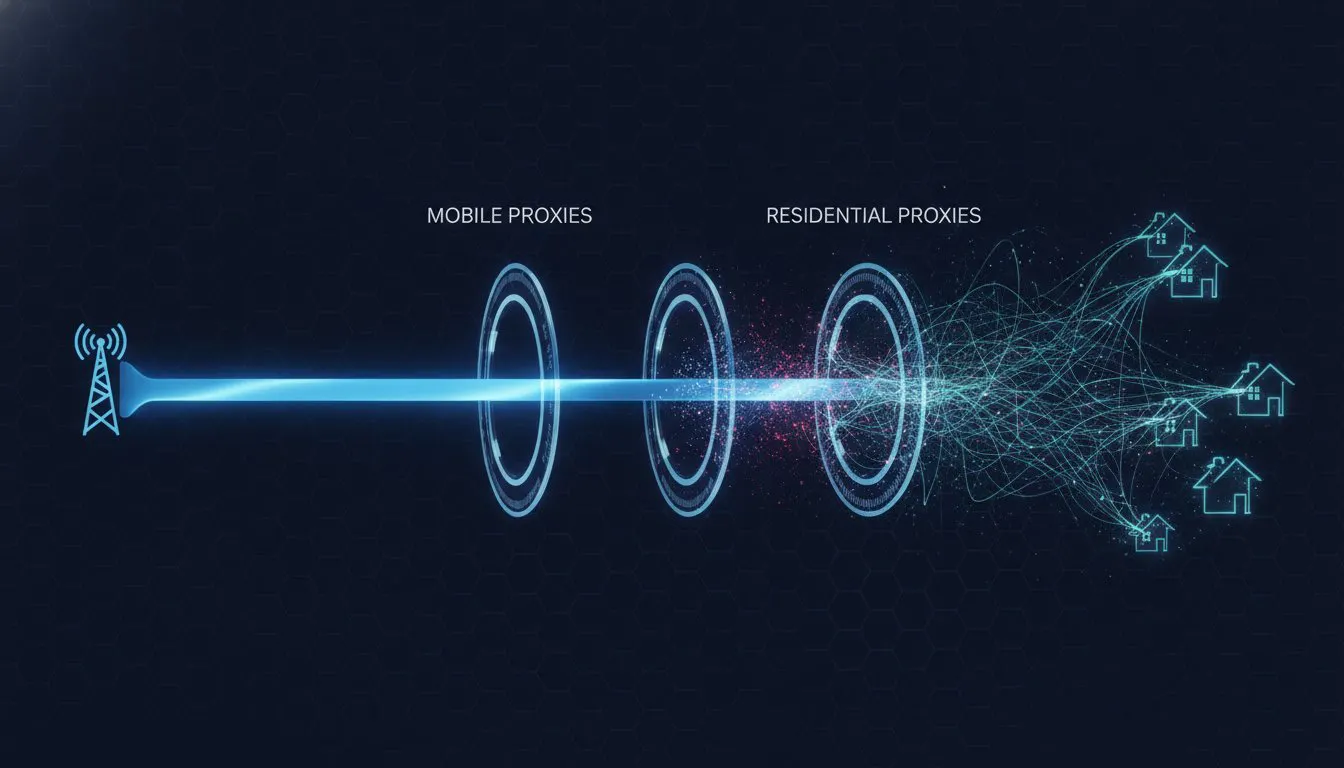
Datacenter IPs are the easiest to detect. Since they originate from servers rather than consumer ISPs, platforms flag them for multi-account management almost immediately. Residential proxies offer better anonymity by using home Wi-Fi connections, but they often struggle with session stability. If an IP changes mid-session, it can trigger security checkpoints. Mobile proxies represent the gold standard. They provide the highest level of trust because they're indistinguishable from real smartphones, offering the stability and reputation needed for long-term account maintenance.
The Concept of 'Digital Reputation' in 2026
Your digital footprint is analyzed through the lens of carrier metadata and IP history. Platforms assign trust scores based on whether your connection looks like a standard consumer mobile device. High trust scores enable more efficient automation, as platforms are less likely to throttle or verify accounts that appear to be on a legitimate cellular network. Digital Reputation is the cumulative trust score an account earns through consistent mobile IP usage.
The Technical Advantage: CGNAT and High-Trust IPs
The primary technical reason mobile IPs carry such high reputation is Carrier-Grade NAT (CGNAT). Unlike residential or datacenter connections where one IP usually maps to one household or server, mobile carriers route thousands of distinct users through a single public IP address. This architectural necessity creates a massive trust advantage. When you're using mobile proxies for account management, you're essentially hiding in plain sight among a crowd of legitimate cellular traffic.
Platforms like Facebook, Instagram, or Amazon are hesitant to ban a mobile IP address because doing so results in significant collateral damage. If a security system blocks one suspicious mobile IP, it might inadvertently disconnect hundreds of paying customers or active users in the same geographic area. This creates a "trust shield" for your operations. By utilizing SMS Activation alongside these high-trust IPs, you establish a digital footprint that looks identical to a standard retail consumer.
Understanding CGNAT and IP Sharing
Technically, one mobile IP can represent an entire city block of users. This high density is why rotating mobile proxies are superior to static versions for managing multiple accounts. While a static IP eventually becomes tied to a specific set of behaviors, a rotating proxy allows you to cycle through a carrier's entire reputation pool. This "Invisibility in a Crowd" strategy is vital for creating new profiles, as it prevents platforms from linking separate accounts to a single source. It's much harder for an algorithm to justify a ban when the source IP is shared by five thousand real people.
Passive OS Fingerprinting and Proxy Sync
Proxy usage is only half the battle. Platforms use passive OS fingerprinting to see if your browser's data matches the carrier's expected headers. If your IP says you're on a 5G network in New York, but your browser fingerprint shows a Windows desktop with a London timezone, the account will be flagged. Successful managers ensure that their User-Agent reflects a mobile device and that WebRTC data is properly masked to prevent leaks. Using anti-detect browsers is the standard way to synchronize timezones, languages, and screen resolutions with your proxy's location. For developers, the verification half of this setup can be automated through the Anosim API (v1), while the proxy side stays with the API of your proxy provider — our partner proxied.com.
The Account Lifecycle: From SMS Verification to Management
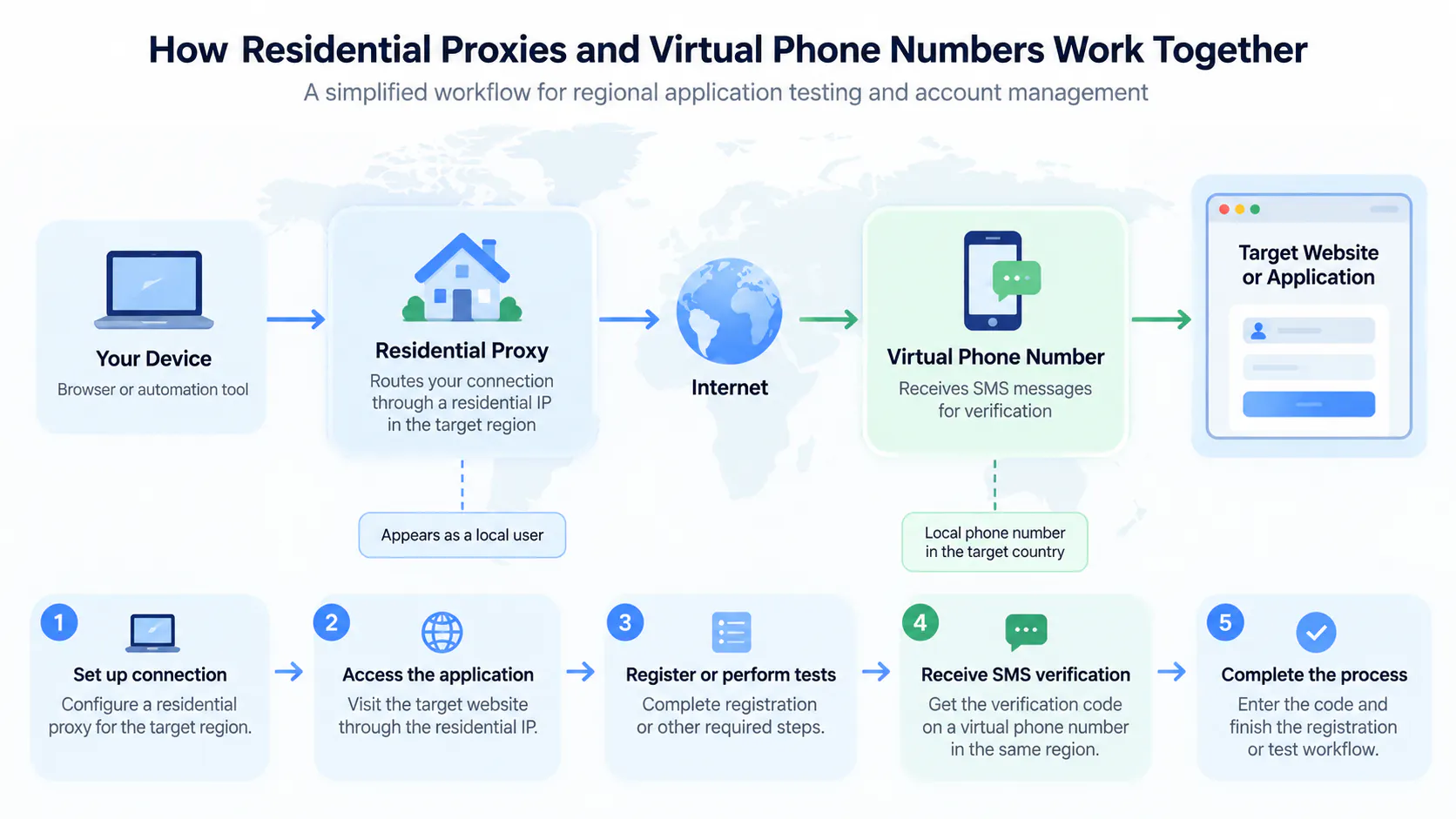
Successful account management requires more than just masking your location. It requires a synchronized dual-layer strategy: a high-trust IP and a verified digital identity. In 2026, the primary reason for shadowbanning during registration is the technical mismatch between these two layers. When you use a datacenter IP to complete an SMS verification, platform security systems immediately detect the discrepancy between a consumer-grade phone number and a server-grade network. This inconsistency is a major red flag. By using mobile proxies for account management from the very first click, you ensure your network signature matches your identity signature.
The synergy between Anosim's SMS activation service and mobile proxies provides a seamless technical framework for growth. Consider a scenario where you're creating a TikTok account. If you use a residential IP that's been flagged for previous scraping activity, your new account starts with a low trust score. However, using a clean mobile IP through a cellular gateway ensures the account is categorized as a legitimate mobile user. This distinction determines whether your content reaches the intended audience or remains restricted from the public feed.
Step 1: Account Creation with Trusted SMS
High-trust account creation relies on virtual numbers that platforms recognize as non-VoIP. Whether you're managing profiles on Telegram or Tinder, using virtual numbers for OTP verification is the first step in establishing a long-term presence. For high-value accounts, one-time activations might not be enough. In these cases, opting for a long-term number rental is the more secure choice. It allows for future re-verification if the platform triggers a security check. For a deeper dive into these strategies, you can explore our guide on Mobile VoIP for account creation.
Step 2: Transitioning to Long-Term Proxy Management
Once the account is live, the focus shifts to maintaining session stability. Using mobile proxies for account management requires sticky sessions, which keep your account on the same IP location or carrier gateway for the duration of a task. Frequent geographic jumps between logins are a common trigger for automated account locks. You must also manage session cookies carefully. These small data files prove to the platform that you're the same user who logged in previously. Finally, ensure geo-consistency by matching the country of your SMS number with the location of your proxy. A US-based number paired with a European IP is an avoidable technical error that compromises your digital reputation.

Scaling Safely: How Many Accounts per Mobile Proxy?
Determining the correct ratio of accounts to IP addresses is the most critical step in scaling your operations. If you attempt to register ten profiles on a single IP without rotation, the platform's anti-spam filter will likely flag the entire batch. Successful scaling requires a clear distinction between the account creation phase and the long-term management phase. While using mobile proxies for account management allows for higher density than datacenter IPs, pushing the limits too far leads to proxy overload. You'll recognize this through frequent CAPTCHAs, sluggish load times, or sudden session drops.
During the creation phase, the safest protocol is to create only one or two accounts per IP rotation. Platforms are hyper-sensitive to bursts of registration activity coming from the same network gateway. Once accounts are established and "warmed up," you can increase the density. For maintenance, a single high-quality mobile proxy can often support three to five aged accounts, provided their activity is staggered and doesn't overlap in a way that suggests automation.
Platform-Specific Thresholds
Different platforms have varying levels of tolerance for shared IP addresses. Instagram and TikTok utilize aggressive behavioral analysis; they're sensitive to IP changes and high-speed automation. On these platforms, keeping a 1:1 or 1:2 ratio is recommended for high-value profiles. E-commerce platforms like Amazon or eBay have even lower tolerances. They require dedicated sticky IPs to avoid geo-mismatches that trigger immediate "suspicious activity" locks. Conversely, social messaging apps like Telegram or WhatsApp generally trust mobile IPs more, though they remain sensitive to bulk creation patterns. If you're managing a large portfolio, using our Rent Service ensures you have the consistent, dedicated numbers needed to maintain these thresholds.
IP Rotation Strategies for Large Portfolios
Managing hundreds of accounts requires a sophisticated rotation strategy. You must choose between timed rotations or API-triggered rotations. Timed rotations are efficient for general browsing, but API-triggered rotations are superior for account creation because they allow you to request a fresh IP immediately after a successful registration. This ensures each new identity starts with a clean slate. You should also implement a "warm-up" period where new accounts perform low-risk actions on the mobile proxy before starting heavy automation. Finally, always use a proxy manager with a built-in kill-switch. This prevents "IP leaks" by cutting the internet connection if the proxy fails, ensuring your real IP is never exposed to the platform's security systems.
Ready to scale your operations without the risk of bans? Secure your infrastructure by browsing our Rent Service for long-term account stability.
Automating Verification Workflows with the Anosim API
Manual management is not a scalable strategy for agencies handling hundreds of high-value profiles. To achieve true operational efficiency, using mobile proxies for account management must be integrated into a programmatic workflow. Programmatic access allows you to synchronize the rotation of high-trust IPs with the precise moment of identity verification. By utilizing the Anosim API (v1), you can automate the verification half of that workflow — requesting a number, polling for the incoming code, releasing it again — while the connection itself stays with your proxy provider's API, ensuring your infrastructure remains invisible to anti-fraud systems.
Verification workflows often require handling high volumes of data across multiple platforms. Anosim provides compatibility with the SMS-Activate Standard API, allowing developers to swap existing integrations without rewriting their entire codebase. For platforms that utilize voice-based verification instead of text, mobile VoIP rentals provide the necessary inbound infrastructure to receive automated calls programmatically. This level of automation reduces human error and ensures that every account in your portfolio maintains a consistent digital reputation.
Developer Integration: SMS and Proxy APIs
A standard automation script for account creation follows a logical, conditional progression. First, your script calls the proxy provider's API to ensure a fresh cellular IP is active and matches the target geographic location. Second, it uses the Anosim API to request a virtual number for a specific service. Third, the script inputs the provided number into the platform's registration field. Fourth, it polls the Anosim API at regular intervals to retrieve the incoming verification code. Finally, the script submits the code and saves the session cookies to maintain the account's "sticky" connection for future logins.
The Future of Account Management: AI and Mobile Proxies
As we move further into 2026, AI-driven automation is becoming the standard for social media and e-commerce management. These AI agents require even higher-trust infrastructure because their behavioral patterns can sometimes trigger subtle red flags. Mobile proxies are the only viable path for AI-managed personas because they provide the "human" noise necessary to blend into cellular traffic. Building a resilient digital infrastructure with Anosim tools allows you to deploy advanced automation with the confidence that your underlying network stays secure. This reliance on robust mobile environments is shared by many modern professional applications; for example, you can explore PHOTO iD Mobile App Subscription to see how automated photo labeling is transforming property inspections. By combining API-driven SMS activations with mobile network routing, you create a trust-shield that is virtually impossible for platforms to penetrate without blocking thousands of legitimate users.
Mastering digital anonymity requires a shift from hiding your presence to blending into legitimate mobile traffic. Using mobile proxies for account management provides the necessary trust shield through CGNAT, ensuring your operations remain indistinguishable from real cellular users. When you synchronize these high-reputation IPs with trusted SMS verification, you close the security gaps that lead to shadowbans and restrictions. This dual-layer approach is the most effective way to maintain a clean digital footprint as platform algorithms become more sophisticated.
Efficiency at scale is only possible through programmatic integration. By leveraging the Anosim API (v1) and Anosim's network of real mobile numbers, you can automate complex verification workflows while maintaining a perfect digital fingerprint. Our services provide the technical robustness needed for high-volume tasks, offering compatibility with the SMS-Activate Standard API for seamless transitions. Scale your account management with high-trust mobile proxies from our partner proxied.com and SMS activations from Anosim. You now have the technical framework to manage high-value portfolios with confidence and precision. Success in modern account management isn't about luck; it's about building on a stable, professional foundation.
Frequently Asked Questions
How many accounts can I run on one mobile proxy?
For account creation, you should limit activity to one or two profiles per IP rotation to avoid triggering anti-spam filters. Once accounts are established, you can safely manage three to five profiles on a single mobile proxy by staggering login times. Overloading a proxy with too many concurrent sessions leads to slow performance and increased CAPTCHAs. Maintaining a conservative ratio is the most reliable way of using mobile proxies for account management.
Is it better to use a mobile proxy or a residential proxy for Instagram?
Mobile proxies are significantly more effective for Instagram because they leverage Carrier-Grade NAT (CGNAT) technology. Instagram's security algorithms are less likely to ban mobile IPs since doing so would block thousands of other legitimate cellular users. While residential proxies are useful for web scraping, they often lack the high trust score required for long-term social media management. Using mobile proxies ensures your accounts appear as genuine retail users on a cellular network.
Why do my accounts get banned even when using a mobile proxy?
Bans often occur due to browser fingerprint leaks or inconsistent identity data rather than the IP address itself. If your WebRTC, timezone, or canvas data doesn't match your proxy's location, platforms will flag the account as suspicious. Additionally, using low-quality VoIP numbers for verification instead of non-VoIP SMS activations can trigger immediate restrictions. A mobile proxy is a powerful tool, but it must be paired with clean hardware fingerprints and trusted identity verification.
Can I use mobile proxies for account creation and management at the same time?
You can use the same proxy infrastructure for both tasks, but you must rotate the IP address between creation and management sessions. It's best practice to create an account on a fresh IP, then switch to a "sticky" session for daily management tasks. This separation prevents platforms from linking your newly created profiles to your established ones. Consistent IP rotation is a core part of using mobile proxies for account management at scale.
Do I need an anti-detect browser if I'm already using mobile proxies?
Yes, an anti-detect browser is essential for preventing platforms from identifying your real hardware and operating system. A mobile proxy only masks your IP address; it doesn't hide the browser headers that reveal you're using a desktop computer. Anti-detect tools allow you to synchronize your User-Agent, screen resolution, and fonts with your mobile proxy's network data. Without this synchronization, your connection looks like a desktop user trying to hide behind a cellular gateway.
What is the difference between a rotating and a sticky mobile proxy?
A rotating proxy provides a new IP address at set intervals or upon an API request, which is ideal for bulk account creation. A sticky proxy maintains the same IP or gateway for a longer duration, providing the session stability needed for consistent account logins. For management tasks, sticky sessions are preferred because they mimic the behavior of a real user staying on one network. Rotating proxies are better suited for tasks requiring high anonymity and fresh start points.
How do I match my mobile proxy with my SMS verification number?
You should always match the geographic location of your proxy with the country of your SMS verification number. If you use a US-based mobile proxy with a European phone number, platform security systems will flag the account for a location mismatch. For the highest trust scores, try to match the specific carrier or region when possible. Using Anosim's Rent Number service allows you to secure long-term access to numbers that align perfectly with your proxy's network origin.
Is it legal to use mobile proxies for managing multiple accounts?
Using mobile proxies is generally legal for privacy protection and legitimate business operations like social media management or market research. However, you must always comply with the Terms of Service of the platforms you're accessing and adhere to local data privacy laws. While proxies provide anonymity, they don't grant permission to engage in illegal activities or bypass platform security for malicious purposes. Always use these tools responsibly to maintain your professional digital reputation.