Most "virtual" numbers you find online are essentially useless for modern API verification because platforms have blacklisted nearly every major VoIP range. If you've tried to automate account creation on high-security platforms lately, you've likely faced the frustration of "unsupported number" errors or high-latency OTPs that expire before they arrive. Finding a reliable virtual mobile number for developers has become a game of avoiding low-trust signals that trigger anti-fraud systems. It's clear that the standard, generic approach to SMS automation no longer meets the requirements of a production-ready environment.
We understand that manual verification is a bottleneck you can't afford in a high-volume workflow. This guide will help you master the technical nuances of programmatic SMS verification and learn how to integrate high-trust, mobile-originated numbers into your stack. We'll examine the 2026 landscape of A2P 10DLC compliance, the shift toward real SIM-based rentals, and how to use the SMS-Activate Standard API to ensure your automated accounts stay active and verified.
Key Takeaways
- Learn how to identify high-trust numbers that bypass the sophisticated anti-fraud filters used by platforms like Google and Tinder.
- Evaluate the technical differences between one-time SMS activations and long-term rentals when choosing a virtual mobile number for developers.
- Integrate the Anosim API (v1) into your software stack to programmatically manage number procurement and verification workflows.
- Strengthen your anonymity stack by pairing mobile-originated numbers with mobile proxies to align IP geolocation with number origin.
- Implement bulk activation protocols to scale your verification operations efficiently for enterprise-level automation projects.
The Developer’s Challenge: Why Standard Virtual Numbers Fail
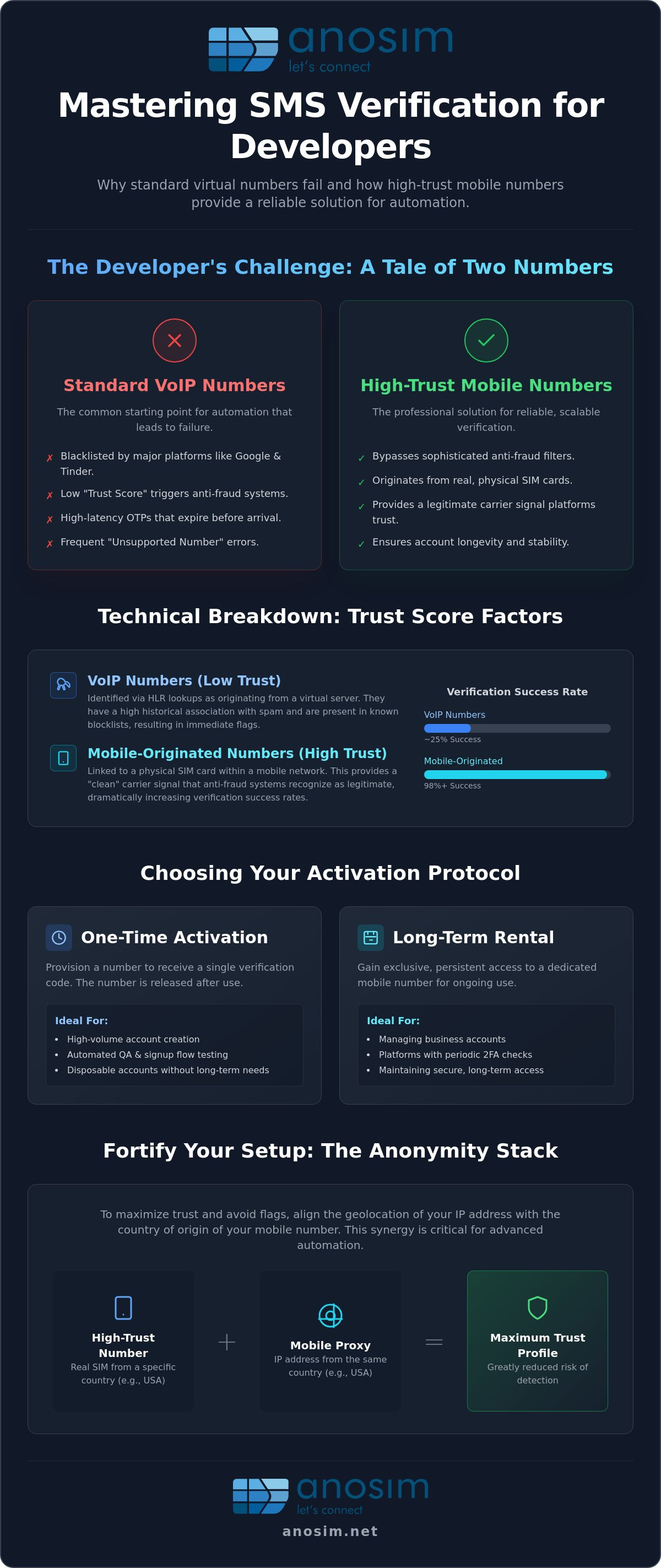
Most developers begin their automation journey by reaching for a standard virtual mobile number, assuming that any digital line will suffice for an OTP. In 2026, this assumption is often the primary cause of script failure. Modern anti-fraud systems now assign a "Trust Score" to every phone number used during registration. This score isn't a static value. It's a real-time calculation based on the number’s carrier type, its historical association with spam, and its presence in known VoIP databases.
Platforms like Telegram, Tinder, and Google maintain extensive blacklists of non-mobile number ranges. If your verification request originates from a known VoIP range, the target platform's anti-fraud engine will likely flag the account for immediate review or block the SMS delivery entirely. This creates a significant hurdle for scaling operations. Securing a high-trust virtual mobile number for developers is no longer optional; it's a technical requirement for bypassing these automated blocks. Without dedicated infrastructure for inbound SMS activation, your automation workflows will remain fragile and prone to sudden interruptions.
VoIP vs. Mobile-Originated Numbers
The technical distinction between landline-based VoIP and mobile-originated (MO) numbers is what determines your success rate. Services distinguish between these types through HLR (Home Location Register) lookups, which reveal whether a number is assigned to a physical SIM card or a virtual server. Numbers tied to real SIM infrastructure provide "clean" signals that improve account longevity and stability. Mobile-originated numbers are the gold standard for developer verification because they provide a legitimate carrier signal that anti-fraud systems trust. Using these numbers ensures that your accounts aren't flagged as bot-generated during the first 24 hours of existence.
The Cost of "Free" Virtual Number Services
While public SMS pools might seem attractive for quick testing, they introduce severe privacy risks and operational inefficiencies. These public numbers are recycled constantly. You'll frequently encounter "number already used" errors, or worse, find that a previous user still has access to the account you're trying to create. In a production environment, these high failure rates lead to wasted API credits and stalled development cycles. Professional-grade rentals are essential for developers who need persistent access or high-volume activations. Relying on a dedicated virtual mobile number for developers ensures that you have exclusive access to the inbound SMS stream, which is critical for maintaining the security and integrity of your automated accounts.
SMS Activation Protocols: Choosing Between Instant and Long-Term
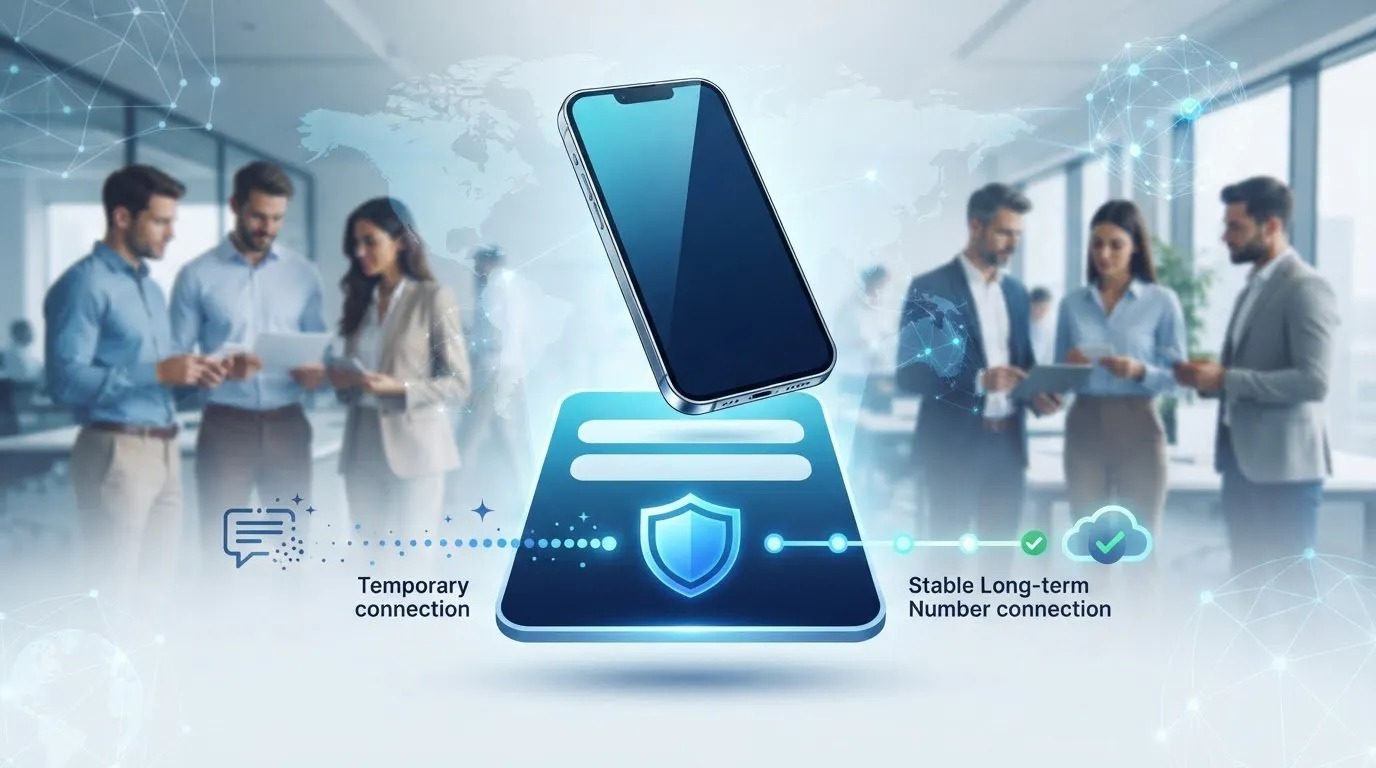
The choice between a one-time activation and a long-term rental depends entirely on your application's lifecycle. An SMS Activation is a programmatic transaction where a number is provisioned specifically to receive a single verification code. Once the OTP is delivered, the number is released back into the pool. This is the standard approach for high-volume account creation where persistent access isn't required. However, developers must align these choices with evolving security standards. The NIST Digital Identity Guidelines highlight the risks associated with restricted number types, making it vital to select a service that offers high-trust mobile ranges rather than recycled VoIP lines.
For applications requiring ongoing authentication, a Rent Number service is the superior technical path. This protocol provides exclusive, long-term access to a specific mobile line. It's particularly useful for managing business communication stacks or platforms that trigger periodic 2FA checks. Anosim facilitates these workflows by providing reliable inbound SMS capabilities across more than 53 countries. Whether you're integrating an SMS Activation for a quick test or a monthly rental for a production account, the infrastructure must support the specific platform's trust requirements.
Scenario 1: Rapid Testing and Disposable Accounts
Automated QA testing of signup flows demands a high volume of unique identifiers without the overhead of long-term contracts. Instant activations are ideal for these use cases because they allow you to manage costs in high-volume automated testing environments. By integrating a virtual mobile number for developers into your CI/CD pipelines, you can simulate real-world user registration without using personal hardware. This approach ensures your code handles SMS delivery latencies and verification failures gracefully before reaching production.
Scenario 2: Persistent Identity and Account Recovery
Production environments often require a stable digital footprint for client account management. If a service requires recurring 2FA or account recovery via SMS, a one-time activation will lead to permanent account lockout. Choosing a Rent Number service ensures you maintain a dedicated number that isn't shared with other users. This isolation significantly increases account security and prevents the "number already used" errors common in shared pools. For developers building long-term automation tools, a dedicated virtual mobile number for developers is the only way to guarantee persistent access and reliable account recovery.
API Integration: Automating Verification into Your Stack
Transitioning from manual verification to a fully automated workflow requires a robust interface that minimizes latency. Integrating a virtual mobile number for developers into a production stack is most efficient when using a direct HTTP-based approach. This avoids the overhead of complex SDKs that often include unnecessary dependencies. The process is straightforward and follows a logical sequence designed for high-concurrency environments.
- Step 1: Authentication. Begin by authenticating your requests using the Anosim API (v1). Most developers prefer passing the API key as a query parameter or within the request header to initiate a session.
- Step 2: Number Procurement. Select the target service and country. For instance, if you're automating a Telegram registration, you'll specify the service code alongside the country ID to receive a number tailored for that platform's specific filters.
- Step 3: Programmatic Polling. Once the number is provisioned, your script should enter a polling loop. You'll periodically request the status of the activation to check for the inbound SMS payload.
- Step 4: Parsing and Execution. After the API returns the message body, use a regex pattern or JSON parser to extract the digits of the OTP. Your application then submits this code to the target platform to complete the verification.
Dual Compatibility: Anosim API and SMS-Activate Standard
One of the primary technical advantages of this infrastructure is its dual compatibility. The system supports both the native Anosim API (v1) and the SMS-Activate Standard API. This is critical for developers performing legacy migrations; if your existing code already uses the standard industry protocol, you don't need to rewrite your entire integration. The Anosim API (v1) remains the lightweight choice for new projects, offering a clean, RESTful structure that’s easy to implement in Python or Node.js without excessive boilerplate code.
Handling Webhooks and Polling Mechanisms
Optimizing how you retrieve verification codes is essential for reducing total execution time. While some systems rely on webhooks, a controlled polling mechanism often provides better reliability in high-latency environments. We recommend a polling interval of 5 to 10 seconds to balance speed with API rate limits. Your error handling must programmatically manage "No SMS Received" scenarios by setting a timeout threshold. If a code doesn't arrive within a specified window, your script should automatically cancel the activation and request a new virtual mobile number for developers to maintain the flow of your automation pipeline.
The Anonymity Stack: Combining Virtual Numbers with Mobile Proxies
A virtual mobile number for developers provides the necessary identity for verification, but the IP address provides the critical context. If you attempt to register an account using a high-trust mobile number while routing your traffic through a data center IP, anti-fraud systems will identify the mismatch immediately. This discrepancy signals automated activity, often leading to an instant shadowban or a request for additional "human" verification steps. To achieve a successful automation flow, you must implement an anonymity stack that pairs mobile-originated numbers with mobile proxies.
Mobile proxies route your data through real cellular network infrastructure, assigning your session an IP address that belongs to a legitimate mobile carrier. This creates technical synergy with your virtual number. When both the number and the IP address originate from the same carrier type, your digital footprint appears identical to that of a genuine retail user. Anosim functions as a unified platform for these requirements, offering both Mobile Proxies and SMS services to ensure your automation environment remains consistent and high-trust.
Bypassing Geofencing and Regional Restrictions
Regional consistency is the primary rule of automated account creation. If you procure a virtual mobile number for developers from the Czech Republic, your proxy IP must also originate from the Czech Republic. Modern apps use geofencing to detect "impossible travel" scenarios where a registration attempt happens in one country while the phone number is registered in another. Matching these locations ensures that your digital fingerprint remains stable during the entire signup process. This consistency is vital for global apps that have strict regional verification requirements, such as localized fintech or social media platforms.
High-Trust Proxies for Account Management
The role of IP reputation is the silent partner of SMS verification. Unlike residential proxies, which can sometimes be flagged if the home network is compromised, mobile proxies benefit from CGNAT (Carrier-Grade NAT) technology. This means thousands of legitimate users share a single mobile IP, making it nearly impossible for platforms to blacklist the IP without affecting real customers. Using clean mobile proxy IPs prevents your accounts from being flagged post-verification, which is a common issue when using cheaper, shared proxy pools. For developers building long-term account management tools, this infrastructure is non-negotiable.
To secure the infrastructure needed for high-trust automation, you can get started with mobile proxies today to complement your SMS verification workflow.
Scaling Your Operations with Anosim Virtual Infrastructure
Scaling an automation project requires more than just a functional script. It demands an infrastructure capable of handling hundreds or thousands of simultaneous requests without triggering rate limits or detection. When you integrate a virtual mobile number for developers into a large-scale project, you're essentially building a gateway to global digital platforms. Anosim provides the backend for these bulk SMS activation tasks, ensuring that concurrent sessions don't result in blocked numbers or expired OTPs. This high-concurrency capability is what separates a professional development workflow from a basic testing setup.
Managing international operations involves navigating a complex web of country-specific carrier regulations and service-specific filters. A unified platform simplifies this by offering a global pool of numbers through a single API entry point. You can switch between regions instantly to satisfy local verification requirements across more than 53 countries. This flexibility is supported by two distinct financial models: pay-per-activation for high-volume, disposable account creation, or monthly rentals for services that require long-term stability. Choosing the right model depends on your specific volume and the expected lifecycle of the accounts you're managing.
From Local Testing to Global Deployment
Moving from local testing to global deployment involves more than just changing a country code in your script. You must account for varying latencies and the specific "trust score" requirements of regional apps. Integrating Anosim into enterprise-level account management tools allows you to programmatically manage diverse service-specific requirements. This transition is smoother when you leverage technical support to align the API's capabilities with your custom developer requirements. Ensuring that your global verification infrastructure remains robust is the key to maintaining account longevity as you expand your digital footprint.
Future-Proofing Your Verification Flow
The anti-bot landscape of 2026 is increasingly sophisticated, making it essential to stay ahead of detection trends. Relying on high-trust mobile-originated numbers is the only way to ensure your verification flow remains viable. A reliable partner for inbound-only communication provides the stability needed to maintain thousands of active accounts over time. As platforms implement more aggressive verification checks, having a flexible and technically sound infrastructure becomes your competitive advantage. To ensure your automation projects remain efficient and secure, you can scale your verification workflow with Anosim API and maintain a reliable virtual mobile number for developers across all your target platforms.
Optimizing Your Verification Infrastructure for 2026
Successful automation in 2026 requires a shift from generic VoIP to high-trust infrastructure. You've seen how mobile-originated numbers bypass strict anti-fraud filters and why matching your IP geolocation with your number's origin is critical for account longevity. By implementing the Anosim API (v1), you can programmatically manage these assets to eliminate the bottlenecks of manual verification and reduce operational latency.
Securing a reliable virtual mobile number for developers is the foundation of a scalable automation stack. Whether you're conducting rapid QA testing or managing a global fleet of accounts, the right infrastructure ensures your OTPs arrive without delay. Anosim provides global coverage for over 100 digital platforms, delivering the stability and technical robustness your production environment demands. It's time to move beyond fragile workarounds and build a verification flow that scales with your needs.
Get Started with Anosim API for Secure SMS Verification
Frequently Asked Questions
How does a virtual mobile number for developers differ from a standard VoIP number?
A virtual mobile number for developers differs from standard VoIP because it uses real mobile carrier infrastructure rather than landline-based data center ranges. Most high-security platforms can detect VoIP headers and will block verification attempts immediately. By using mobile-originated numbers, you provide the trust signals necessary to bypass anti-fraud filters that flag purely digital virtual lines.
Can I use the Anosim API to automate SMS verification for Telegram and WhatsApp?
Yes, you can use the Anosim API (v1) to automate verification for Telegram, WhatsApp, and over 100 other digital platforms. The system allows you to specify a target service code during the procurement process. This ensures the number provided is optimized for that specific platform's security protocols and is less likely to be flagged during the registration flow.
What is the difference between SMS activation and long-term number rental?
SMS activation is a one-time transaction designed for a single OTP verification. Once the code is received, the session ends. A Rent Number service provides persistent access to a specific line for a set duration, such as a week or a month. You should choose the rental model if your application requires recurring 2FA or account recovery to avoid permanent lockouts.
Is the Anosim API compatible with the SMS-Activate Standard API?
The Anosim infrastructure is fully compatible with the SMS-Activate Standard API. This allows you to migrate existing automation scripts without rewriting your entire integration logic. You can use your current protocols while benefiting from the high-trust mobile-originated numbers provided by the Anosim network. The Anosim API (v1) remains available as a lightweight alternative for new projects.
Do I need a mobile proxy to use a virtual number for verification?
While not strictly required for the API to function, using a mobile proxy is essential for successful account creation on high-trust platforms. Anti-fraud systems check for a mismatch between the phone number's origin and your session's IP address. Pairing a virtual mobile number for developers with a mobile proxy from the same region creates a consistent digital fingerprint that reduces shadowban risks.
How long does it take to receive an SMS code through the API?
Most SMS codes arrive within 5 to 60 seconds after the request is initiated. The actual delivery time depends on the target platform's SMS gateway and current network congestion. If a code isn't received within a few minutes, the Anosim API allows you to cancel the activation programmatically so you can request a new number without wasting your balance.
Are these numbers physical SIM cards or virtual instances?
These numbers are based on real physical SIM cards hosted in secure server environments, not virtualized software instances. This technical foundation allows them to pass HLR lookups and carrier-type checks. By providing a legitimate mobile network signal, these numbers offer higher reliability for OTP delivery compared to software-generated lines that lack a physical carrier anchor.
What should I do if a virtual number is flagged as "already in use" by an app?
If a platform flags a number as "already in use," you should immediately cancel the activation through the API and request a replacement. This happens occasionally with recycled numbers in the telecommunications industry. The Anosim system doesn't charge for activations that don't successfully receive an SMS, allowing you to cycle through numbers until you find a clean one for your registration.