Why are you still managing a drawer full of physical SIM cards when your competitors are scaling with a single line of code? You already know that manual SMS entry is a logistical nightmare for bulk account management. Relying on standard VoIP numbers is equally frustrating, as services like Telegram and Google now routinely block low-trust virtual ranges. It is a technical bottleneck that prevents your automation from reaching its full potential.
This 2026 guide is designed to solve that infrastructure challenge. You will learn how to implement a robust SMS verification API integration that captures inbound OTPs directly into your application logic. By utilizing high-trust virtual numbers and standardized protocols, you can bypass carrier filtering and ensure high deliverability for every activation.
We will walk through the programmatic capture of inbound messages using the Anosim API (v1) and the SMS-Activate Standard API. From navigating the latest A2P 10DLC requirements to selecting the right mobile proxies for global operations, this overview provides the technical roadmap you need for reliable, hands-free verification at scale. You can expect a direct look at the mechanics of inbound-only numbers and how they provide the stability your workflows require.
Key Takeaways
- Understand how virtual number gateways intercept cellular signals to provide reliable JSON payloads for seamless programmatic parsing.
- Master the implementation of a professional SMS verification API integration using Anosim API (v1) and the SMS-Activate Standard API to eliminate manual latency.
- Determine when to utilize cost-effective SMS Activations for bulk tasks versus long-term Rent Number services for accounts requiring persistent 2FA access.
- Learn to align your virtual numbers with high-trust mobile proxies to bypass geo-fencing and sophisticated carrier filtering.
- Transition from unscalable physical SIM logistics to a programmatic infrastructure designed for high-volume automation and digital privacy.
Table of Contents
- Overcoming the Scalability Wall of Manual SMS Verification
- The Architecture of Inbound SMS Capture and Programmatic Parsing
- Choosing Between One-Time Activations and Long-Term Virtual Number Rentals
- Integrating the Anosim API (v1) and SMS-Activate Standard API
- Scaling Global Operations with High-Trust Mobile VoIP and Proxies
Overcoming the Scalability Wall of Manual SMS Verification
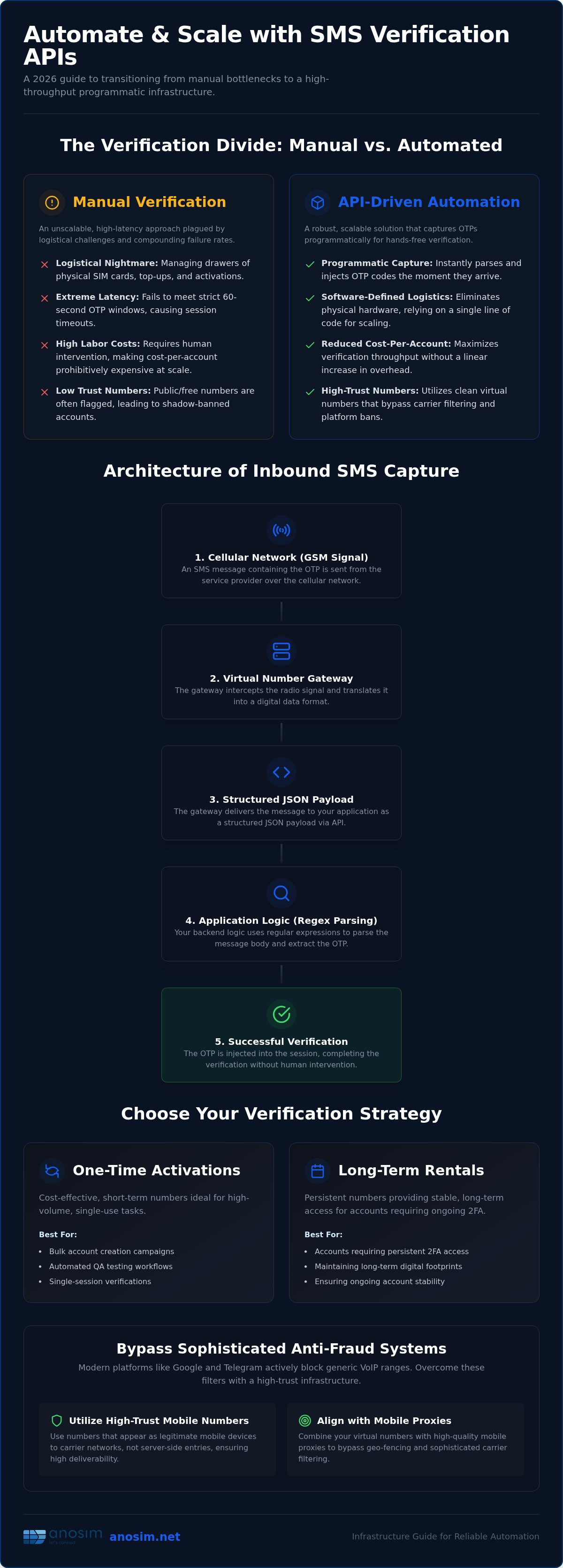
Manual verification is a bottleneck. It is the operational death-spiral for any growing automation project. If you are managing 10 accounts, it is a nuisance; if you are managing 1,000, it is impossible. Most platforms enforce a strict 60-second window for telephone number verification. If your team cannot retrieve and input that code before the session expires, the workflow breaks. This latency creates a compounding failure rate that manual entry simply cannot solve. Programmatic capture ensures that the code is parsed and injected the moment it hits the gateway, preserving the integrity of the session.
Then there is the physical logistics. Maintaining rows of SIM cards in a drawer is unscalable. You deal with activation dates, balance top-ups, and the constant risk of physical damage. It's a hardware-heavy approach in a software-driven world. Beyond the logistical mess, using public "free" numbers leads to account shadowing. These numbers are often flagged by security algorithms, resulting in instant bans for any account associated with them. When a number is "shadowed," the platform might let you create the account but will restrict its functionality or shadow-ban its content immediately, wasting your setup time.
The Economics of Programmatic Verification
Manual labor is the most expensive component of account management. When you switch to an SMS verification API integration, you eliminate the need for human intervention. This shift reduces the cost-per-account significantly for marketing agencies and QA departments. For those in the real estate sector who want to implement high-level automation, learn more about SOAVerify to see how their platform streamlines the leasing process for landlords and property managers. You don't have to pay a team to sit and watch for inbound messages. Verification throughput is the total number of successful SMS code captures and injections completed within a fixed timeframe without human oversight. By optimizing this metric, you can scale your operations without a linear increase in overhead costs.
Modern services like Telegram and Google have sophisticated filters that detect and block generic VoIP ranges. They look for patterns associated with low-trust virtual numbers that have been recycled across thousands of accounts. To maintain high deliverability, you need infrastructure that offers high-trust mobile VoIP and dedicated rentals. These numbers appear as legitimate mobile devices to carrier networks rather than server-side entries. For a deeper look at maintaining digital footprints, see our Temporary Phone Number: 2026 Privacy Guide. Using an SMS verification API integration allows you to swap numbers instantly if a specific range becomes saturated, ensuring your automation remains operational at all times.
The Architecture of Inbound SMS Capture and Programmatic Parsing
Building a successful SMS verification API integration requires a deep understanding of the underlying signal path. Unlike outbound messaging, which pushes data to a carrier, inbound capture requires a virtual number gateway to intercept GSM signals. These gateways act as terminal points within the cellular network, receiving the radio frequency transmission and translating it into a digital format. By converting these signals into a structured JSON payload, the system allows your application to interact with cellular data as if it were a standard database entry. This infrastructure is the backbone of high-volume automation, ensuring that every incoming packet is accounted for and ready for parsing.
Once the JSON payload is delivered, your application logic must extract the specific One-Time Password (OTP). This is usually achieved through regular expressions (Regex) designed to identify 4 to 8-digit numeric strings within the message body. During high-volume bursts, such as a bulk account creation campaign, data integrity is paramount. Your backend must be capable of handling concurrent requests without dropping packets or misallocating codes to the wrong session. Ensuring this reliability is a core part of adhering to security standards like NIST on Multi-Factor Authentication, which highlights the necessity of secure and timely delivery for verification tokens.
Polling vs. Webhooks: Choosing the Right Integration Path
Your choice of integration path depends on the duration of the number usage. For a standard SMS Activation, where the number is short-lived, API polling is often the most efficient method. Your script repeatedly checks the gateway for a status change until the message is received. This keeps the logic simple and reduces server-side overhead for one-off tasks. If you are using a Rent Number service for long-term access, implementing webhooks is the superior choice. Webhooks push the data to your server the moment it arrives, which is essential for managing recurring codes or 2FA recovery over several days. You can review the Anosim API (v1) technical documentation to determine which method fits your current stack.
The Technical Workflow of a Verification Request
The lifecycle of a request begins with a POST command to the API, specifying the service and country required. The gateway assigns a virtual number and begins monitoring for inbound traffic. Handling service-specific delays is a critical skill; platforms like WhatsApp or Tinder may have staggered delivery times depending on their current fraud-detection load. Your integration must include optimized retry logic to account for these carrier-side latencies without timing out prematurely. "Headless" automation requires robust error handling at the API level to manage these edge cases gracefully. Once the code is parsed, a final command releases the number, closing the session and freeing up resources for the next request in your queue.
Choosing Between One-Time Activations and Long-Term Virtual Number Rentals
Selecting the right infrastructure for an SMS verification API integration depends entirely on the lifecycle of the accounts you are managing. Developers often face a choice between transient, one-time activations and persistent virtual number rentals. While both utilize the same underlying cellular gateways, their utility varies based on the platform's security logic and your long-term recovery needs. A one-time activation is essentially a burner line; it provides a code and expires shortly after. A rental, conversely, offers a dedicated line that remains active for days or months, allowing you to receive subsequent codes if a platform triggers a security check or requires 2FA for a new login.
Strategic Use Cases for SMS Activations
If your workflow involves mass account creation for social media marketing, software testing, or data scraping, SMS Activation is the most cost-effective path. These are high-volume, low-cost solutions designed for services that only require a phone number during the initial sign-up phase. For example, creating 500 accounts for a localized marketing campaign doesn't justify the overhead of 500 monthly rentals. In these scenarios, the goal is to maximize verification throughput. You get the code, parse it via the API, and move to the next instance. This model keeps your operational costs proportional to your actual usage and prevents resource waste.
When Dedicated Rentals are Essential
Certain platforms require "sticky" numbers to maintain account stability. High-value identities on Telegram, Business WhatsApp, or Tinder often trigger periodic re-verifications. If you used a one-time activation, you'd lose access to the account the moment the platform asks for a new code. This is where a Dedicated Virtual Number for SMS becomes a technical necessity. It provides a stable anchor for your digital footprint, ensuring that your automated bots or professional profiles don't get locked out during a routine security sweep. This dedicated infrastructure is also vital for managing accounts that require 2FA recovery, where losing the number means losing the entire digital asset.
From an ROI perspective, the decision usually comes down to the frequency of access. A pay-per-activation model offers the lowest entry price, but if you find yourself re-registering the same accounts every week due to bans, the monthly rental becomes the cheaper option. A monthly rental provides predictable costs and eliminates the latency of requesting new numbers for existing accounts. It also improves your trust score with platform algorithms, as a consistent phone number is a strong signal of a legitimate user. By matching your service type to your account longevity goals, you ensure that your SMS verification API integration remains both lean and resilient.
Integrating the Anosim API (v1) and SMS-Activate Standard API
In 2026, the SMS-Activate Standard API has become the industry benchmark for programmatic verification. This standardization is critical because it allows developers to maintain a consistent codebase while switching between infrastructure providers. By adopting this standard, you ensure that your SMS verification API integration remains flexible and future-proof. The integration process begins with authentication. You must secure your requests using a unique API key, typically passed as a parameter in every GET or POST request. This key is your credential to the global gateway, granting access to thousands of inbound-only numbers across various regions.
The second step involves selecting your parameters. Using the getNumbers endpoint, or its equivalent, you programmatically define the target country and the specific service, such as Google, Telegram, or WhatsApp. This call returns a unique number ID and the virtual phone number itself. Once the number is assigned, you move into the management phase. By monitoring the getStatus payload, your application tracks the lifecycle of the transaction from "Waiting for SMS" to "Received." This structured approach ensures that your automation logic can respond instantly to incoming data packets without any manual oversight.
Leveraging the Anosim API (v1) for Custom Workflows
While the standard API is excellent for general compatibility, the Anosim API Documentation provides mapping for unique endpoints that tap into specialized global infrastructure. This version is optimized for high-trust mobile VoIP and dedicated rentals, offering more granular control over number longevity. Handling error codes correctly is the hallmark of a senior developer. You must write logic to manage responses like "No Numbers Available" by implementing a fallback to a different region or "Wait for SMS" to maintain the polling state. These specific endpoints allow for more resilient workflows when dealing with highly restricted digital environments.
Automating the Retrieval Process
Efficiency in automation requires a clean polling loop. You should write your script to check for the verification code at set intervals, typically every 5 to 10 seconds, to avoid hitting rate limits or triggering anti-spam filters. Once the code is extracted, your script should immediately issue a "Finish" command. This tells the gateway that the transaction is successful, releasing the number and optimizing your budget by preventing unnecessary rental extensions. API standardization prevents vendor lock-in for growing automation fleets, allowing you to scale your infrastructure as your account volume increases. If you're ready to start building, you can review our full API documentation to see how these endpoints integrate with your existing stack.
Scaling Global Operations with High-Trust Mobile VoIP and Proxies
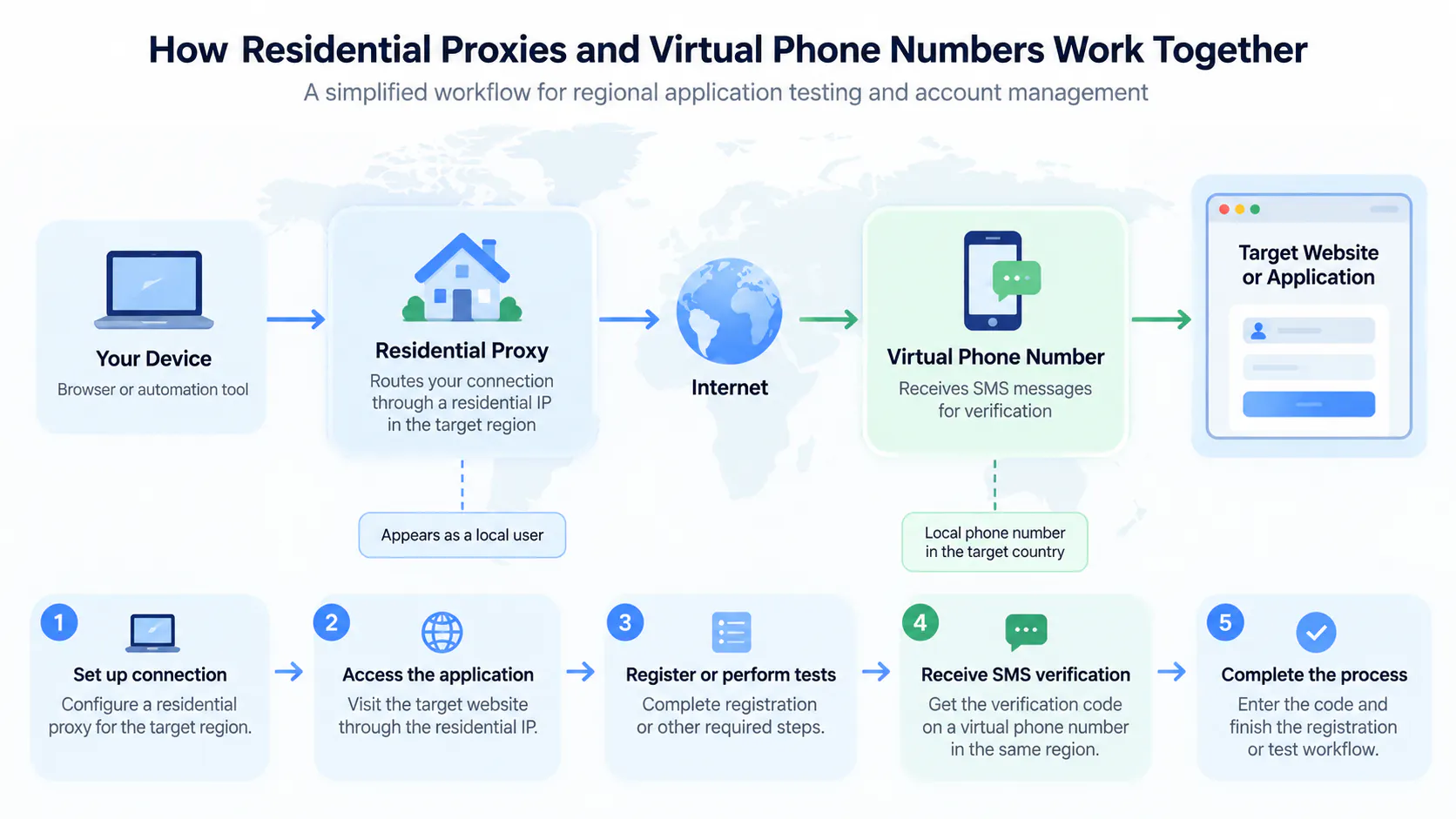
Scaling global operations is a multi-dimensional challenge that requires more than just a functional SMS verification API integration. It requires a synchronized digital identity. For developers looking to verify identities in the Brazilian market, you can learn more about SOAWebServices to access official data query APIs that strengthen your verification process. This is often referred to as the Mobile Identity Triad. For an account registration to be successful, the region of the virtual number must match the geolocation of the IP address. if you attempt to verify a German Telegram account using a US-based IP, the platform's security logic will likely flag the attempt as high-risk. Matching these data points is the only way to ensure long-term account stability and bypass sophisticated geo-fencing.
Inbound-only services provide a distinct advantage in this area. Because these numbers are dedicated to receiving data rather than sending it, they are rarely associated with outbound spam campaigns. This results in cleaner number pools with higher trust scores from major platforms. Using virtual infrastructure also protects your private data. By isolating your automated signups from your personal telecommunications history, you eliminate the risk of data leaks and cross-platform tracking that often occurs with physical SIM cards.
The Mobile Proxy Synergy
Account creation often fails because of the IP address, not the phone number. Even with a high-trust virtual number, a data center IP will trigger anti-fraud filters on apps like Google or WhatsApp. To achieve maximum trust, you must match your virtual numbers with Mobile Proxies from our partner proxied.com. These proxies provide the residential cellular IP addresses that platforms expect from legitimate mobile users. When scaling to 1,000+ accounts, distributing your API requests across rotating mobile IPs prevents any single address from being rate-limited or blacklisted.
Next Steps for Developers
If you are managing a high-volume automation fleet, setting up an Anosim Reseller account provides the administrative tools needed to manage large-scale number allocations. For specific platform troubleshooting or integration edge cases, we recommend reviewing our FAQ. You can also browse our Rent Service to see the full list of currently supported platforms and regions. Transitioning to a fully automated, proxy-aligned infrastructure is the final step in building a resilient, scalable digital operation that respects both efficiency and privacy.
Future-Proofing Your Automation Infrastructure
Transitioning to a programmatic model is no longer optional for high-volume operations. By moving away from the logistical burden of physical SIM cards and adopting a robust SMS verification API integration, you ensure your workflows remain resilient against evolving anti-fraud filters. The synergy between high-trust inbound numbers and mobile proxy infrastructure is the definitive standard for 2026. This specific architecture allows you to maintain digital anonymity while maximizing verification throughput across global platforms without the risk of account shadowing.
Reliability in automation depends on the quality of your underlying gateways. Utilizing inbound-only infrastructure and standardized protocols like the Anosim API (v1) and SMS-Activate Standard API provides the stability required for enterprise-level scaling. Whether you need transient activations for bulk tasks or long-term rentals for sensitive accounts, the right toolset eliminates technical bottlenecks. It's time to replace manual latency with programmatic precision.
Start Scaling Your SMS Automation with Anosim Today. Building a resilient automation fleet starts with choosing a partner that prioritizes high-trust delivery and technical standardization.
Frequently Asked Questions
How do I programmatically receive an SMS verification code via API?
You receive a code by sending a GET or POST request to the API to order a number for a specific service. Once the number is assigned, your script enters a polling loop to check the status of the transaction. When the gateway intercepts the inbound message, it returns the parsed code in a JSON payload. This SMS verification API integration ensures that the data is injected directly into your application logic without manual entry.
What is the difference between SMS activation and virtual number rental?
SMS activation is a transient service designed for a single verification code, expiring immediately after use. It is ideal for bulk account creation where long-term access isn't required. Virtual number rental, or Rent Number service, provides a dedicated line for a fixed duration. This is necessary for accounts requiring persistent 2FA or recovery options, as it allows you to receive multiple codes over several days or weeks.
Can I use an SMS verification API for apps like Telegram or Tinder?
Yes, you can use these APIs for high-security platforms like Telegram or Tinder. These services often require high-trust mobile VoIP numbers rather than generic virtual ranges. Using an SMS verification API integration with mobile-aligned infrastructure increases your success rate. It's important to match the number's country with your connection's geolocation to avoid being flagged by the platform's internal fraud detection systems.
Why are some virtual numbers blocked by Google or WhatsApp?
Major platforms like Google and WhatsApp maintain extensive blacklists of known VoIP provider ranges. If a number range is heavily associated with automated spam or low-trust server environments, it will be blocked instantly. Using inbound-only mobile numbers helps bypass these filters. These numbers appear to the network as legitimate cellular devices, which carries a much higher trust score than standard virtual lines or recycled public numbers.
How do webhooks work for automated SMS verification?
Webhooks function as a reverse API call where the SMS gateway pushes data to your server URL as soon as a message arrives. Instead of your script repeatedly asking if a code has been received, the gateway sends a POST request with the message content. This method is highly efficient for long-term rentals and high-volume workflows because it reduces server overhead and ensures near-instantaneous data capture for your automation logic.
Do I need a mobile proxy to use an SMS verification API?
While not strictly mandatory for the API to function, a mobile proxy is essential for account stability. Platforms check if your IP address matches the region of the phone number you are using. If you use a German number with a US data center IP, the account will likely be restricted. Mobile proxies provide authentic cellular IP addresses, creating a consistent digital footprint that satisfies the platform's security algorithms.
Is it legal to use an API for SMS verification automation?
Using an API for verification is a standard technical practice for privacy and testing, but you must adhere to the specific platform's Terms of Service. Most regions allow the use of virtual numbers for data privacy and account management. However, using these tools for prohibited activities like spamming or fraud can lead to legal consequences. Always ensure your automation workflows comply with local data protection regulations and the service provider's acceptable use policies.
What is the SMS-Activate Standard API and why is it used?
The SMS-Activate Standard API is a widely adopted protocol that provides a uniform set of endpoints for number ordering and status checks. It is used because it prevents vendor lock-in; developers can switch between different infrastructure providers without rewriting their entire integration. This standardization makes it easier to scale automation fleets, as you can leverage multiple gateways while maintaining a single, consistent codebase for your verification tasks.